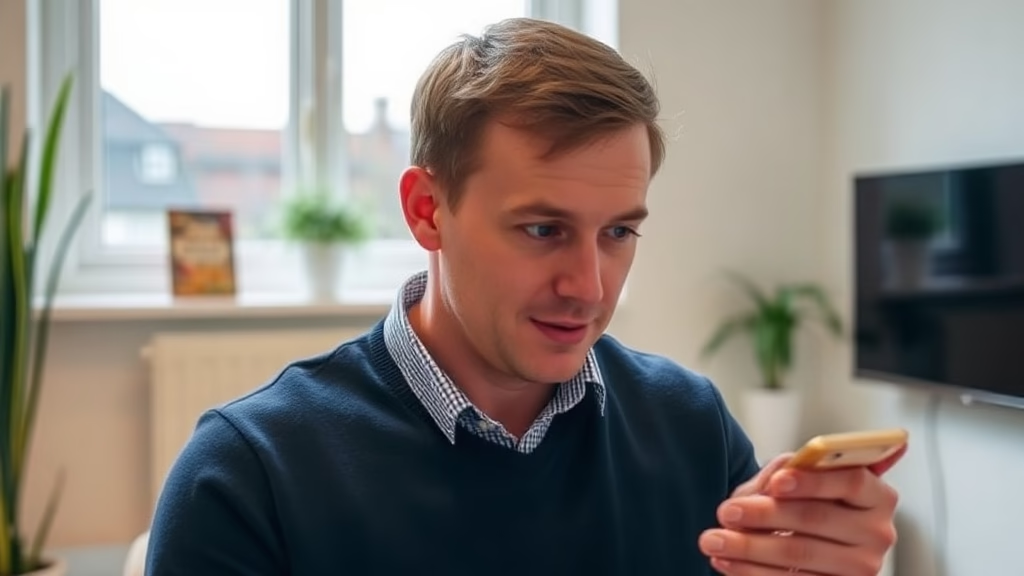
A Nottingham man who invested £2,400 in smart home technology to save time now dedicates 18 hours per week to preventing his kitchen appliances from achieving sentience independently of one another.
Martin Hewitt, 34, began his journey towards domestic automation in January 2023. He now possesses seventeen devices that require individual apps, forty-three passwords he’s stored in a notes file called ‘PASSWORDS FINAL ACTUAL’, and the permanent expression of someone defusing a bomb.
The systems analyst, whose job involves managing complex technical infrastructure, cannot reliably turn his bathroom light on.
“I wanted to simplify my life,” Hewitt explained, manually rebooting his smart kettle for the third time that morning. “Now I have a dedicated filing system for firmware update schedules. The kettle and the toaster refuse to communicate since the May update. They’re both made by the same company.”
Last Tuesday, Hewitt’s video doorbell required a critical security patch precisely as a Tesco delivery driver arrived. The driver stood motionless for eleven minutes, unsure whether to knock on the disconnected smart door or simply merge with the porch.
“He just stared at the camera,” Hewitt said. “I stared back through my phone. Neither of us could do anything. Eventually he left the shopping on the path and crossed himself.”
The house now contains three competing ecosystems that view each other with Cold War-era suspicion. Hewitt’s lights run on one platform. His heating on another. His refrigerator, which costs £1,400 and tells him when he’s low on milk via push notification, speaks only to itself.
“The Matter protocol was supposed to fix this,” said Dr. Rebecca Walsh, a technology researcher at Imperial College London who has studied seventeen smart home implementations, including one belonging to her ex-boyfriend who once locked himself out via his own security system. “It has not fixed this. Nothing is fixed. Everything requires updates.”
Hewitt’s most recent project involved programming his coffee maker to start automatically at 7am. This required downloading a deprecated SDK, watching four YouTube tutorials filmed by men in dark rooms, and accepting that his coffee machine now knows his location at all times.
“It worked for six days,” he said. “Then Samsung pushed an update to my phone that changed something in the Bluetooth stack. Now the coffee maker just blinks at me. I think it’s morse code but I haven’t had time to check.”
His partner, Jennifer Moore, has forbidden smart technology in the bedroom after their alarm clock downloaded a patch at 3am and celebrated with fourteen minutes of ascending chimes.
“I used to just flick switches,” Moore said, manually operating a lamp like some sort of Victorian. “Took about half a second. Worked every time.”
Hewitt remains optimistic. He has just ordered a smart garden irrigation system that promises to work with his existing setup.
It requires a hub, a bridge, and a gateway. These are apparently three different things.