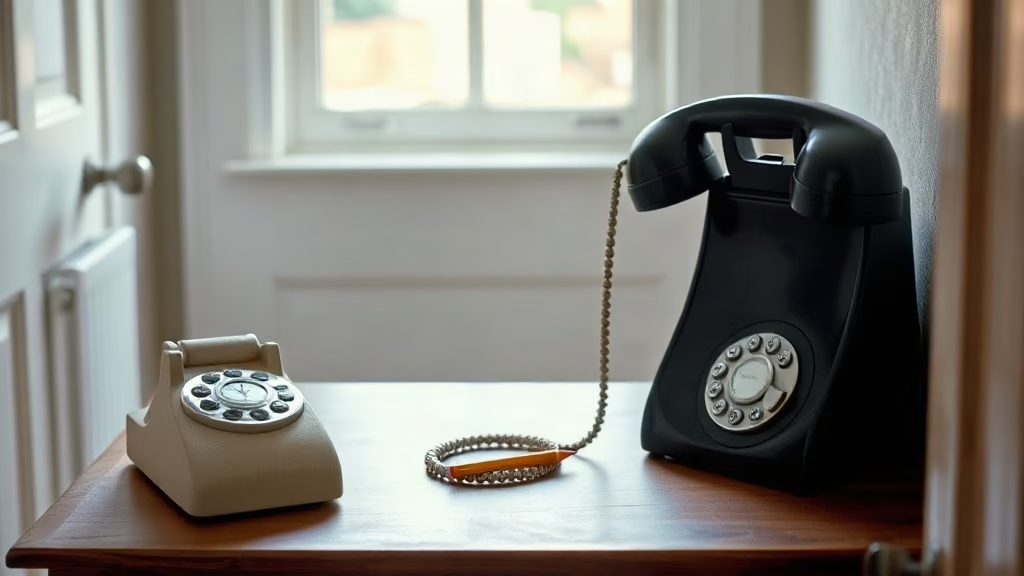
The UK’s old analogue phone network is being retired, with households moving over to internet-based calling by January 2027. The handset will still work. The hallway around it, however, will need a rethink.
Here is what to replace, in order of how long it has been since you moved it.
1. The telephone seat
A small wooden bench with a shelf attached, designed for lengthy conversations with someone called Denise. Nobody has sat on it since 1994. It now holds a stack of catalogues and a hat.
2. The hallway table
Its purpose was to hold the phone. It now holds a bowl of keys, three takeaway menus, one glove, and a battery that may or may not be dead. Do not test the battery.
3. The tiny pencil on a string
Attached to a notepad with a piece of string in 1989. The pencil is four centimetres long and has never once been sharpened. The notepad contains a single message: “Ring Colin.” Nobody knows which Colin.
4. The Yellow Pages
Last consulted during the Blair administration. It now props open the back door, a job it performs with more dignity than it ever showed finding a plumber.
5. The answerphone message
Recorded by a husband in 2003, and never changed. “We can’t come to the phone right now,” he says, in the voice of a man who has been told to speak clearly.
“He sounds like a man who owns a boat,” said Margaret Holroyd, 68, a retired school secretary from Kettering. “He has never owned a boat. I’m not deleting it.”
6. The cream handset
Once cream. Now the colour of a tooth. The curly cord has been stretched to reach the kitchen, and in the process has developed the tensile properties of a garden hose. It has been walked through the house so many times that it holds a shape best described as “Wales”.
7. The numbers written on the wallpaper
Beside the phone, in biro, are the numbers for a plumber, a taxi firm, and someone called “Dad (work)”. Dad retired in 1998. The taxi firm is now a vape shop.
8. The telephone voice
The slightly higher, slightly posher voice used to answer a landline. Dr Helen Marchbanks, a senior lecturer in domestic material culture at the University of Leicester, says it is one of the last surviving regional dialects.
“People say their full number when they answer,” said Dr Marchbanks. “Then they say ‘hello?’ as though the number was a question. We studied 40 households. Six of them were her mother’s.”
9. Pauline
The only person who rings the landline. She calls every Thursday at ten past eleven. She does not want anything. She is, in her words, “just checking it still works”.
Pauline Attwood, 79, a retired dental receptionist from Loughborough, has been checking since 2011. She has never once been asked to stop.
“I let it ring six times,” said Ms Attwood. “Then I say, ‘Oh, you’re there.’ Then I say I’d better go. It’s a system.”
Households are advised to prepare for the switch by making a note of Pauline’s mobile number. She does not have one. She has been advised to get one. She said she would think about it, and would ring on Thursday to let you know.