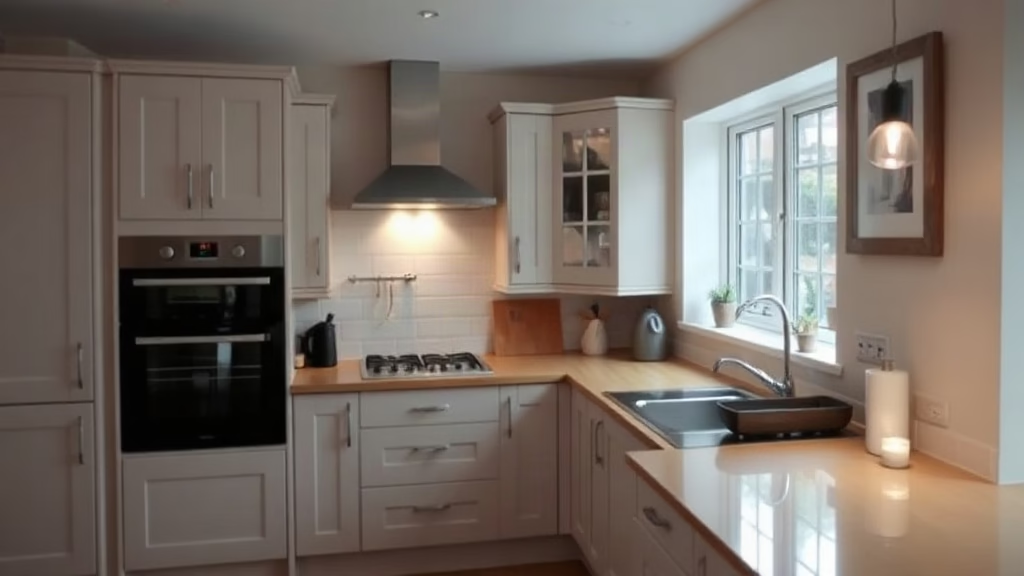
A Bristol man who has invested over £8,000 in smart home technology continues to walk six feet to manually operate his kitchen light switch, it has emerged.
Tom Hendricks, 34, owns three Amazon Echo devices, two Google Nest Hubs, seventeen Philips Hue bulbs, a smart thermostat, four smart plugs, two video doorbells, and a fridge that can tell him when he’s low on milk but cannot, under any circumstances, keep vegetables fresh for more than two days.
The kitchen ceiling light, a single Philips Hue bulb installed in April 2023, has refused to connect to his home network since approximately May 2023.
“I’ve reset it forty-seven times,” Hendricks said. “I’ve deleted the app. I’ve updated the bridge firmware. I’ve performed a ritual sacrifice to the Philips Hue gods. It just blinks at me twice and then does nothing.”
The bulb, which cost £42, sits three metres from a Wi-Fi mesh node that Hendricks installed specifically to improve smart home connectivity. The node cost £280. It now primarily provides internet access to a smart plug controlling a lamp that Hendricks never turns off anyway because the automation routine stopped working in January.
Hendricks’ smart home system theoretically allows him to control every light, socket, and appliance through voice commands or a single app. In practice, he uses seven different apps, none of which communicate with each other, and shouts “Alexa, turn off the bedroom light” between three and eleven times per evening.
“The future of home automation is about seamless integration,” said Jennifer Walters, a smart home consultant who charges £150 per hour to tell people to check if things are plugged in. “We’re very close to achieving that. Perhaps by 2047.”
The Matter standard, introduced in 2022 to unify smart home platforms, has been adopted by four of Hendricks’ devices. None of them are the kitchen light.
Hendricks’ partner, Laura, has begun using the light switch exclusively. She completed a full degree in linguistics in less time than Hendricks has spent reading troubleshooting forums.
“I suggested we just buy a normal bulb,” she said. “He looked at me like I’d proposed we start cooking over an open fire.”
Hendricks remains optimistic that a forthcoming software update will resolve the issue. The update has been “coming soon” since June 2023.
In the meantime, he has purchased a smart button that can be programmed to control the kitchen light. It costs £35 and requires a separate hub. The hub is currently out of stock.
When asked if he considered the investment worthwhile, Hendricks gestured to a wall-mounted tablet displaying his energy usage in real time. The tablet cost £340 and shows that he uses energy. Sometimes more, sometimes less.
“This is the future,” he said, walking to the kitchen to turn the light on manually. “We’re just in a transitional phase.”
The transitional phase is now in its sixth year.