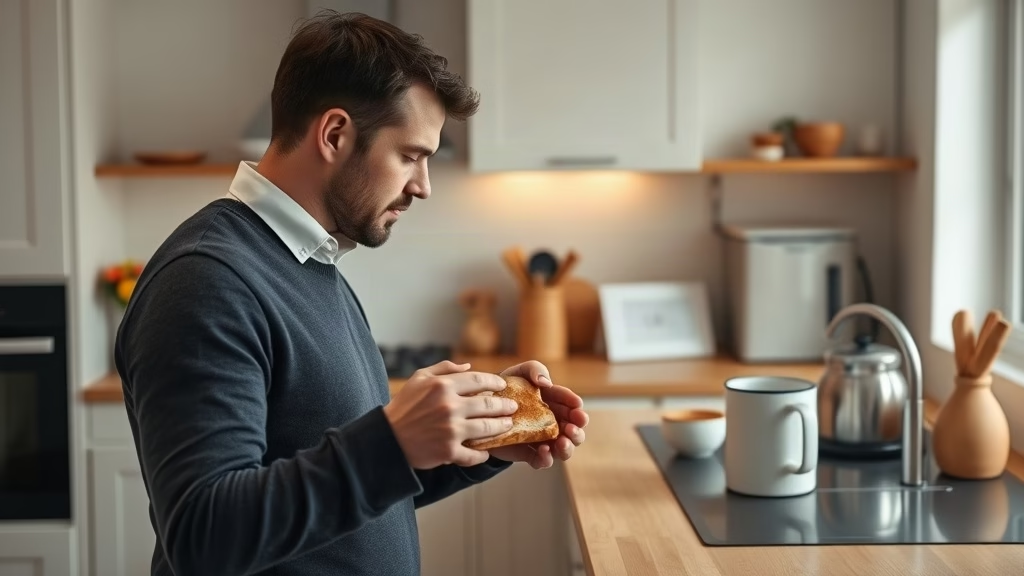
A Manchester man who invested heavily in home automation technology now spends approximately forty minutes each morning mediating between his appliances to achieve what was previously a three-minute task.
Tom Hendricks, 34, began his smart home journey eighteen months ago with a voice-activated assistant. He has since added seventeen connected devices across six incompatible ecosystems, none of which acknowledge the others’ existence.
His Tuesday morning routine now begins at 6:15am, when he asks his voice assistant to start the toaster. The assistant, which controls the smart plug into which the toaster is connected, informs him that the kitchen lights must be on before any cooking appliances can operate. This is a rule Hendricks himself programmed at 2am one Sunday after watching a YouTube tutorial about home automation ‘scenes’.
The lights, however, are controlled by a different app entirely. One that requires a software update.
“The update takes eleven minutes,” Hendricks explained, standing in his dark kitchen holding two slices of Hovis. “I know because I’ve timed it. Multiple times.”
Once the lights are operational, his toaster, a £140 model that can be controlled via Bluetooth, requires him to specify which of eight browning profiles he wants. The device offers sourdough, white, wholemeal, gluten-free, brioche, bagel, crumpet, and ‘artisan’. Hendricks eats Warburtons medium sliced. He has never discovered which setting is appropriate.
“I choose artisan because it sounds nice,” he said. “It burns one side completely black.”
The situation deteriorated last month when Hendricks added a smart smoke alarm to his collection. The alarm, which cost £89 and monitors air quality, now triggers every time the toaster operates on artisan mode. This activates his smart ventilation system, which conflicts with his smart thermostat’s morning heating schedule, causing what Hendricks describes as “a Cold War standoff but in my kitchen”.
Dr. Alison Greaves, a researcher in human-computer interaction at Imperial College London, said the phenomenon is increasingly common. “We’re seeing people add complexity to their lives in pursuit of simplicity,” she noted. “One client told me he’d automated his curtains but now has to get up to close them manually because the motor is too loud for his baby monitor, which alerts him via an app that wakes him up.”
Hendricks remains optimistic that a firmware update, expected sometime in Q3, will resolve the toaster issue. In the meantime, he has placed a £40 order for a smart butter dish that will notify him when his spread reaches optimal softness.
He has not yet considered unplugging anything.
“That would mean I’d wasted the money,” he said, eating cold toast in a room that had just automatically dimmed to ‘evening ambience’ at 7am. “Besides, I’ve nearly got the hang of it.”