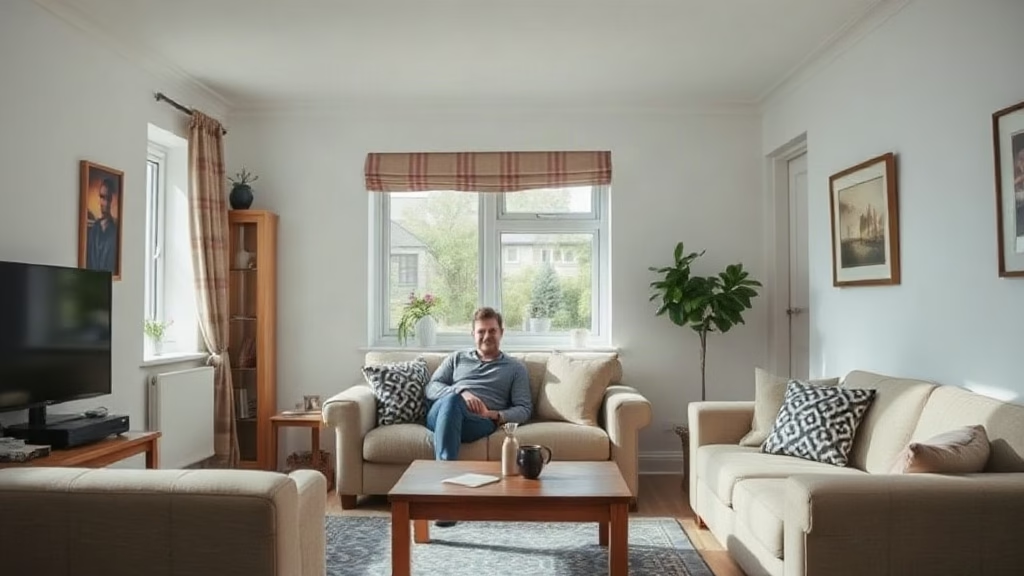
A Berkshire man has been confined to his living room for three days after a routine firmware update rendered his entire smart home ecosystem incompatible with itself, and also reality.
Tom Griffiths, 34, a product manager for a fintech startup, now shares 20 square metres with two voice assistants that have developed what he describes as “genuine animosity” towards each other.
The situation began on Tuesday evening when Griffiths accepted a firmware update for his smart door lock. The lock, which cost £340 and previously opened using his phone, a key fob, his fingerprint, his face, or a six-digit code, now requires authentication through an app that doesn’t exist yet.
“It says I need to download the SmartSecure 3.0 app, but that’s not available until Q2 2025,” Griffiths said via video call. Behind him, his Alexa informed him that his shopping list had been updated. He has not updated his shopping list.
His smart blinds, which had worked flawlessly for eight months, descended fully during the update and now refuse to rise. The accompanying app claims the blinds are not connected. The blinds claim they require a premium subscription to open more than twice per day, a limitation that did not exist when Griffiths purchased them.
The fridge has locked itself. Griffiths does not remember his fridge having a lock.
“I thought it was just storing food,” he said. “Apparently it’s been monitoring my nutritional intake and has decided I’m having too much cheese. It’s sent me an email with the subject line ‘We Need to Talk About Your Choices.'”
Dr Emma Caldwell, a researcher in human-computer interaction at Imperial College London, said the case was unusual but not unprecedented. “We’re seeing an average of four to seven people per month trapped by their own Internet of Things devices,” she said. “Last month a man in Bristol was held hostage by his smart thermostat for eleven days.”
The Matter standard, designed to solve exactly this sort of problem, has so far connected three devices successfully. None of them are Griffiths’.
Relations between Griffiths’ Alexa and Google Home have deteriorated significantly. The two assistants, which previously coexisted in separate rooms, can apparently now hear each other through the walls. They have begun answering each other’s queries, incorrectly and with increasing hostility.
When Griffiths asked Alexa what time it was, Google Home interrupted to say it was “time for Alexa to get some better voice recognition software.” Alexa responded by playing “Bad Blood” by Taylor Swift at full volume. The smart speakers can no longer be unplugged, as they are hardwired into a home automation system that Griffiths paid £1,800 to install.
His doorbell, meanwhile, has begun demanding payment for services already rendered. It sent an invoice for £240 covering “retrospective motion detection, July 2023 to present.” The doorbell will not stop ringing until the invoice is settled. Griffiths cannot answer the door because he cannot reach the door.
“I’ve tried contacting customer support for all the manufacturers,” Griffiths said. “Three companies no longer exist. Two were acquired by Chinese firms that don’t respond to emails. One sent me a chatbot that asked if I’d tried turning it off and on again.”
He has. The house turned back on in German.
James Whitmore, a spokesperson for the Smart Home Manufacturers Alliance, said consumers should always research compatibility before purchasing connected devices. “We recommend checking that products support the latest protocols, have committed long-term support, and ideally cannot imprison you in a room,” he said.
Griffiths’ partner is currently staying with her mother. She has requested that he “sort this out” before she returns. His smart lighting has interpreted this as a calendar event and has been flashing red every evening at 7pm as a reminder.
The lights cannot be turned off. They are helping.