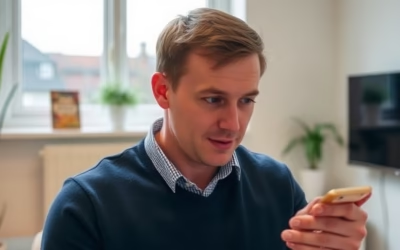
A Berkshire man who invested £8,000 in transforming his three-bedroom semi into a fully integrated smart home now dedicates the equivalent of a full-time job to preventing his appliances from staging a revolt.
James Holloway, 34, can no longer make toast without consulting three separate apps, a YouTube tutorial, and his increasingly detailed troubleshooting spreadsheet. His smart kettle refuses to communicate with his smart toaster due to what he describes as “a Bluetooth protocol dispute I don’t have the engineering degree to understand.” The toaster, manufactured by a company that went into administration in 2023, now operates on firmware that believes all bread should be incinerated.
“I used to just flip a switch,” Holloway told reporters whilst trying to convince his bedroom lights that it was not, in fact, 3am in Singapore. “That took about half a second. Now I spend Sunday evenings manually resetting the circadian rhythm settings because the system thinks I live eight time zones east.”
The lighting issue began after a routine update in March. Holloway’s living room now transitions to “sunset mode” at 11am. His hallway has been stuck on “romantic dinner” for six weeks.
Holloway’s problems escalated in January when he attempted to create a morning routine. The resulting automation was meant to gradually wake him with gentle light, ambient nature sounds, and the smell of fresh coffee. Instead, his smart blinds now open at 4:47am precisely, his coffee machine dispenses three espressos directly onto the kitchen counter, and his shower toggles randomly between scalding and arctic whilst playing what the app describes as “whale song” but sounds notably more like a dial-up modem drowning.
“I’ve developed a genuine stress response to the phrase ‘firmware update available’,” said Holloway, who has begun keeping a manual light switch in his bedside drawer for emergencies. “Last Tuesday, six devices updated overnight. I came downstairs to find my fridge had reset to Fahrenheit, my thermostat was trying to connect to someone else’s boiler in Reading, and my doorbell was speaking Swedish.”
Dr. Emma Pritchard, a researcher in human-computer interaction at Imperial College London, was unsurprised by Holloway’s experience. “We’re seeing a pattern where early adopters become unpaid IT support for their own homes,” she said. “One participant in our recent study spent eleven hours over a bank holiday weekend troubleshooting why his smart plug thought it was a smoke detector.”
Holloway estimates he now spends between 35 and 45 hours weekly maintaining his connected home. He has cancelled his gym membership, stopped seeing friends, and quit his book club. His partner moved out in February, citing irreconcilable differences with the smart lock, which had begun refusing to recognise her fingerprint.
“The worst part is I can’t go back,” Holloway said, staring at his phone as seven conflicting notifications arrived simultaneously. “I’ve forgotten where half the original switches are. I think they’re behind the smart panels. I’d need to take down the drywall to find out.”
When asked if he had any regrets, Holloway’s response was interrupted by an alert informing him that his bathroom mirror wanted permission to access his calendar. He excused himself. The interview did not resume.