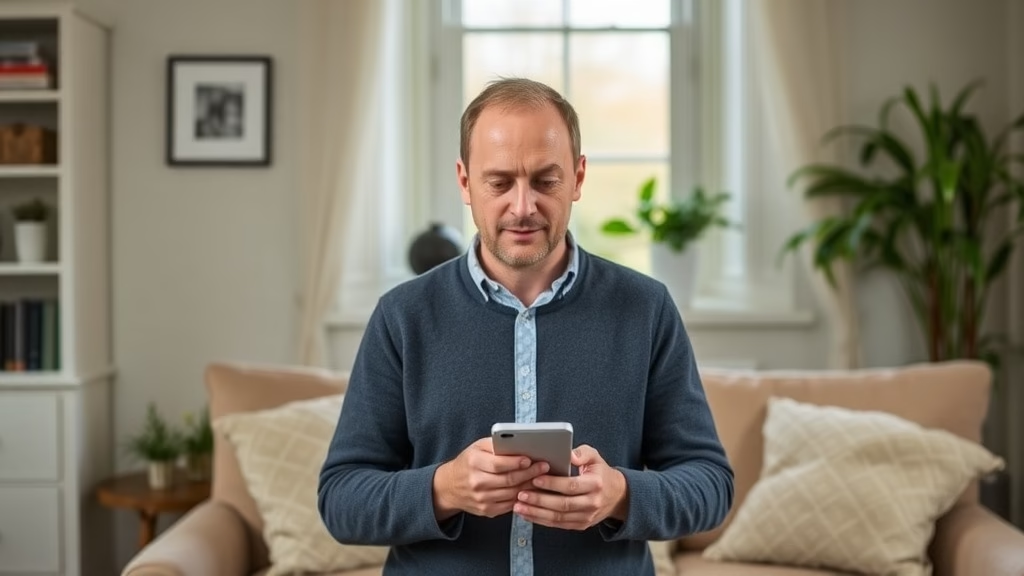
James Pritchard, 34, purchased his first smart bulb in 2021 because he wanted to turn off his bedroom light without getting out of bed. He now owns 47 connected devices and hasn’t had an uninterrupted night’s sleep in eighteen months.
The marketing consultant from Bristol has invested £2,437 in making his three-bedroom semi-detached house “intelligent”. His home can theoretically brew coffee on voice command, adjust heating based on occupancy, and lock doors automatically at bedtime. In practice, it spends most evenings flickering its lights like a possessed Victorian asylum whilst Pritchard crouches behind the sofa trying to get a better WiFi signal to his smart radiator valve.
“The vision was seamless automation,” Pritchard explained, whilst manually rebooting his smart doorbell for the second time that morning. “I’d wake up, the blinds would open, the coffee would be ready, and I’d feel like I was living in the future. Instead I’m living in a perpetual beta test conducted by companies that hate each other.”
His kitchen alone runs on four separate apps. The lights use one ecosystem. The plugs use another. The fridge has its own app, last updated in September 2023, which still sends him a notification every time he closes the door. He has tried to make them communicate via the Matter protocol, the industry’s long-promised universal standard. Two devices are compatible. Neither works.
“Matter was supposed to solve everything,” said Dr. Rebecca Hollings, a consumer technology researcher at Imperial College London. “Eighteen months later, we’ve discovered that the only thing tech companies can agree on is that interoperability is someone else’s problem. Preferably a problem for the customer at 11pm when their smart lock won’t open.”
Pritchard’s daily routine now includes a dedicated troubleshooting window from 6pm to 9pm. Monday is for reconnecting devices that have inexplicably fallen off the network. Tuesday is for firmware updates. Wednesday is for investigating why his smart speaker has started speaking Dutch. He doesn’t know anyone who speaks Dutch. The speaker offered no explanation.
Last month, a brief power cut deleted all his automations. It took him four days to rebuild them. Three still don’t work. His “goodnight” routine now turns off the bathroom light, turns on the garden sprinklers, and sets his thermostat to 4 degrees. He has given up trying to fix it.
“The irony is I bought all this to save time,” Pritchard said, whilst reading a Reddit thread about incompatible Zigbee chipsets. “I could have just walked to the light switch. It was three feet away.”
He estimates he now spends 21 hours per week managing his smart home. That’s longer than his actual commute, which he eliminated by working from home. His house is, technically, very convenient. Assuming nothing updates, disconnects, or decides it no longer recognizes his voice.
When asked if he’d recommend smart home technology to others, Pritchard paused. His kitchen light flickered off. He hadn’t touched anything.
“Only if they’re very patient,” he said. “Or very stupid.”