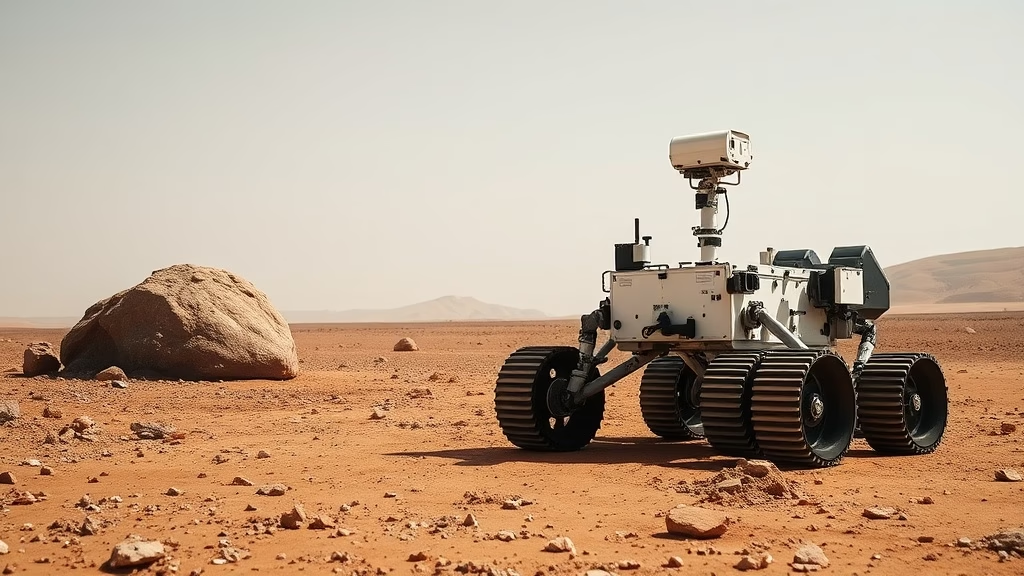
The UK Space Agency has confirmed that its £287 million Mars rover, Perseverance II, has spent the last eleven days locked in what mission control describes as an “unproductive standoff” with a 40cm sedimentary rock formation.
The rover, which landed in Jezero Crater in January, has photographed the rock, designated MGS-4782, more than 600 times. It has circled the formation repeatedly. On three separate occasions, it has extended its robotic arm towards the rock before retracting it without making contact.
“We’re monitoring the situation closely,” said Dr Helen Bartlett, lead robotics engineer at the UK Space Agency’s Milton Keynes facility. “The rover appears to have developed what we can only describe as a grudge. It’s refusing all commands to proceed to the canyon ridge. Every time we input new coordinates, it just takes another photo of that bloody rock.”
The issue first emerged on Sol 289, when the rover’s AI-assisted navigation system repeatedly flagged MGS-4782 as a “potential threat” despite the rock being stationary for approximately three billion years. Since then, the rover has devoted 94% of its operational capacity to observing the formation.
Mission logs show increasingly erratic behaviour. The rover has been using its laser spectrometer to “stare” at the rock for hours at a time. It has repositioned itself to block the rock’s access to sunlight. Yesterday, it transmitted a 40-gigabyte file to Earth consisting entirely of thermal images of MGS-4782 taken at three-minute intervals.
“We’ve tried everything,” said mission commander James Okonkwo, who has worked on four previous Mars missions. “We’ve uploaded new priorities. We’ve recalibrated the sensors. We even tried telling it there are much more interesting rocks 500 metres north. It’s not having it. At this point, the rover’s spent more time obsessing over this one rock than it has on actual geological survey.”
The standoff has cost the mission seventeen critical sampling opportunities. A planned drill operation in a promising clay deposit has been postponed indefinitely. NASA, which provides logistical support for the mission, has begun routing its own rovers around the area to avoid what internal memos describe as “the situation.”
The UK Space Agency maintains that the rover is functioning within normal parameters, albeit extremely stubborn ones. A software patch designed to make the rover “less petty” is currently being tested on Earth-based prototypes.
Dr Bartlett confirmed that the team is considering more drastic measures. “If it doesn’t move by Friday, we’re going to have to drive another rover over there and physically push the rock out of view,” she said. “Which feels like giving in, frankly, but we’re on a budget.”
MGS-4782 could not be reached for comment.