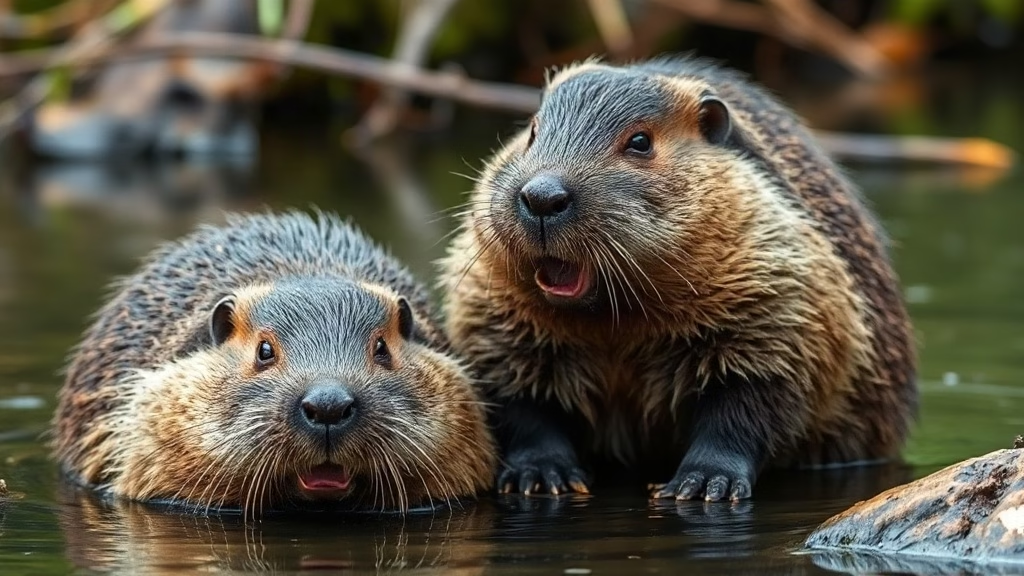
Beavers reintroduced to British waterways as part of the government’s rewilding initiative have formally unionised and submitted a list of demands to the Department for Environment, Food and Rural Affairs, citing substandard working conditions and inadequate healthcare provision.
The newly formed National Union of Reintroduced Beavers has requested improved stream infrastructure, comprehensive dental coverage, and a clarification of liability insurance in cases where their dam-building causes flooding on adjacent farmland. The union represents an estimated 1,200 beavers currently employed across England and Scotland under various rewilding contracts.
According to documents seen by Made Up News, the beavers have complained that many of the streams to which they have been assigned are barely fit for purpose. Several sites in Devon reportedly contain insufficient suitable timber, whilst a pilot programme in Cumbria has been hampered by what union representatives described as “frankly insulting” water quality.
“These beavers were told they’d be returning to pristine natural habitats,” said Martin Fletcher, a wildlife liaison officer who has been mediating between the union and government officials. “What they’ve found instead are degraded waterways, agricultural runoff, and in one case a shopping trolley that had been there since 2003. It’s no wonder they’re upset.”
The dental provisions have proved particularly contentious. Beavers’ teeth grow continuously throughout their lives, requiring constant gnawing to maintain. However, the union argues that the current timber allocation fails to meet basic occupational health standards, with several members reportedly forced to resort to fence posts and garden furniture.
A spokesperson for Defra acknowledged receipt of the demands but noted that the department was still working through a backlog of similar requests from reintroduced red kites, who are seeking danger pay for motorway verge duties.
“We remain committed to rewilding as a cornerstone of our environmental strategy,” the spokesperson said. “However, we would remind all reintroduced species that their presence in Britain is voluntary and that working conditions, whilst perhaps not ideal, represent a significant improvement on being locally extinct.”
The union has rejected this characterisation. In a statement released yesterday, they pointed out that none of the current beaver workforce had actually experienced local extinction personally, and that being asked to feel grateful for barely adequate streams on this basis constituted emotional manipulation.
Sarah Penrose, who manages a rewilding site in East Sussex, expressed sympathy for the beavers’ position. “They were sold a vision of rolling rivers and ancient woodland,” she said. “What we’ve given them is a silted-up drainage ditch next to a caravan park. If I were them, I’d have unionised years ago.”
The union has not ruled out industrial action, though it remains unclear what form a beaver strike might take. Early reports suggest they may simply stop building dams, which would arguably make them indistinguishable from beavers who are working normally but have decided the conditions are not worth the effort.