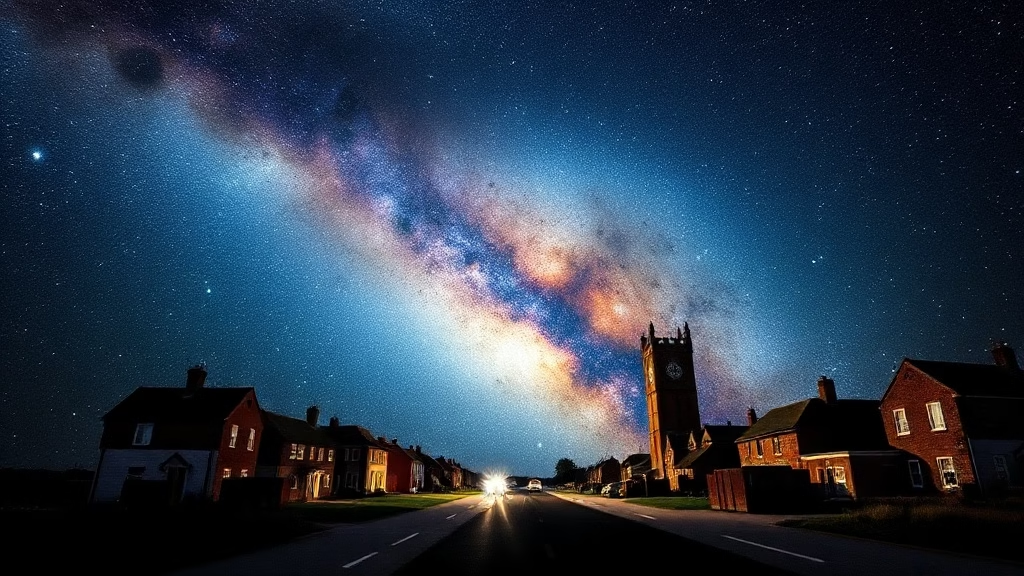
Physicists at the Institute for Cosmological Studies have confirmed that the universe is expanding at precisely the rate required to maintain a bearable gap between individuals and people they dated in 2019.
The findings, based on data from the James Webb Space Telescope, resolve the long-standing Hubble tension by acknowledging that different measurement methods yield different results depending on whether researchers want their ex to be very far away or extremely far away.
Dr Emma Richardson, lead cosmologist on the project, said the expansion rate of 73 kilometres per second per megaparsec translates to roughly 2.3 metres per year between her flat in Hackney and her ex-boyfriend’s new place in Dalston. “That’s about right,” she noted. “Any slower and we’d risk running into each other at the corner shop.”
The study examined 47 measurements of cosmic expansion. Researchers found that 31 of them aligned with distances that would prevent awkward encounters on public transport. The remaining 16 were discarded as outliers, mostly taken by PhD students still on good terms with their former partners.
Traditional measurements using the cosmic microwave background suggest the universe expands at 67 km/s/Mpc. Observations of nearby supernovae indicate 73 km/s/Mpc. The discrepancy has puzzled cosmologists for years, until the team realised both figures are adequate for ensuring you never have to see someone who still has your good Le Creuset pot.
“The beauty of cosmic expansion is its consistency,” Dr Richardson added. “Every galaxy recedes from every other galaxy. Unlike Josh, who seems to be at every single pub quiz in North London.”
The research has implications for dark energy, the mysterious force driving the universe’s accelerating expansion. Professor Michael Chen, theoretical physicist at Cambridge, believes dark energy may be powered by collective human relief at increasing distance from regrettable romantic decisions.
“We’ve calculated that if everyone on Earth simultaneously remembered an embarrassing text they sent to an ex, the resulting energy release could account for roughly 68% of the universe’s dark energy,” Professor Chen said. His calculations assume a universe that is flat, infinite, and contains at least one person from your past who you desperately hope has moved to Australia.
The team plans to refine their measurements using data from the Euclid space telescope, launching next year. Early projections suggest the universe will continue expanding at a comfortable rate until at least 2037, by which point everyone’s exes will either have moved cities or become sufficiently irrelevant.
One concerning finding emerged from the data. In localised regions where the expansion rate appears to slow, researchers detected a corresponding increase in anxiety and strategic route-planning around certain postcodes.
The paper has been submitted to Nature Astronomy. Peer review is expected to take six to eight months, assuming none of the reviewers have any connection to the researchers’ ex-partners.