Scientists at the UK’s National Quantum Computing Centre have celebrated a major milestone after one of their quantum processors remained operational for four consecutive hours on Tuesday.
The achievement, described as “genuinely quite impressive” by project lead Dr Emma Thornton, represents a significant improvement on previous attempts. The centre’s prototype quantum computer has historically maintained coherence for between seven minutes and 45 minutes before experiencing what researchers term “a critical thermal event”, and what the rest of us would call “getting too warm and switching itself off”.
The breakthrough occurred between 1.47pm and 5.52pm, spanning the period when most staff were either at lunch or contemplating their commute home.
“We’re cautiously optimistic that we might achieve a full working day by 2029,” said Dr Thornton, who has been attempting to stabilise the £80 million system since 2021. “Obviously a full 24-hour period remains theoretical at this stage. Let’s not get ahead of ourselves.”
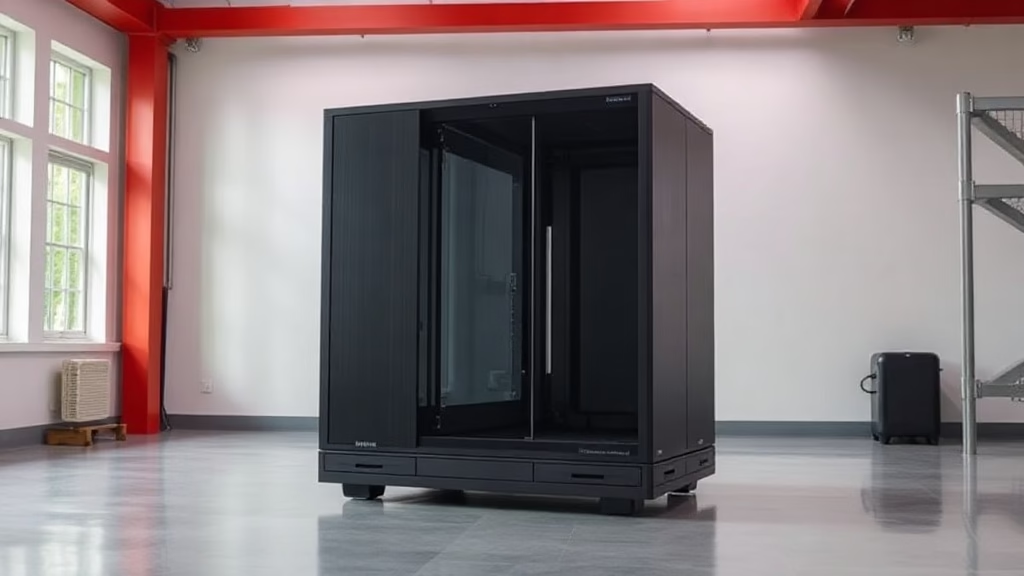
The quantum processor, housed in a facility outside Cambridge, operates at temperatures colder than deep space whilst simultaneously requiring enough electricity to power 400 homes. It achieved the four-hour window by executing a complex series of calculations that a decent laptop could have completed in approximately eleven seconds.
Team member Dr James Okafor noted that the computer managed the feat without anyone accidentally opening the wrong door, triggering the fire alarm, or allowing a software update to install automatically. “All three have been issues in the past,” he confirmed.
The afternoon’s success has been attributed to a combination of factors. These include improved cooling systems, more stable qubits, and the fact that Martin from Facilities finally fixed the air conditioning unit that had been rattling since March.
During its four hours of operation, the quantum computer successfully demonstrated quantum entanglement, achieved superposition across multiple qubits, and calculated several problems that the researchers have described as “potentially relevant to future cryptography applications” and “definitely not just a test to see if it would stay on”.
The breakthrough has been welcomed by the Department for Science, Innovation and Technology, which has invested £2.5 billion in quantum computing research since 2014. A spokesperson said the government remained committed to ensuring Britain leads the world in computers that work for nearly as long as a school sports day.
The NQCC has announced plans to attempt a five-hour window later this month, pending staff availability and assuming nobody needs to use the building’s main power supply for anything else.
Dr Thornton added that the team would be submitting their findings to Nature, though she acknowledged the paper would be quite short. “The main finding is that it stayed on,” she said. “We’ve written 8,000 words about it, but that’s essentially the thrust.”
The quantum computer was unavailable for comment, having been powered down at 5.52pm for routine maintenance. It is not expected to be operational again until late February.