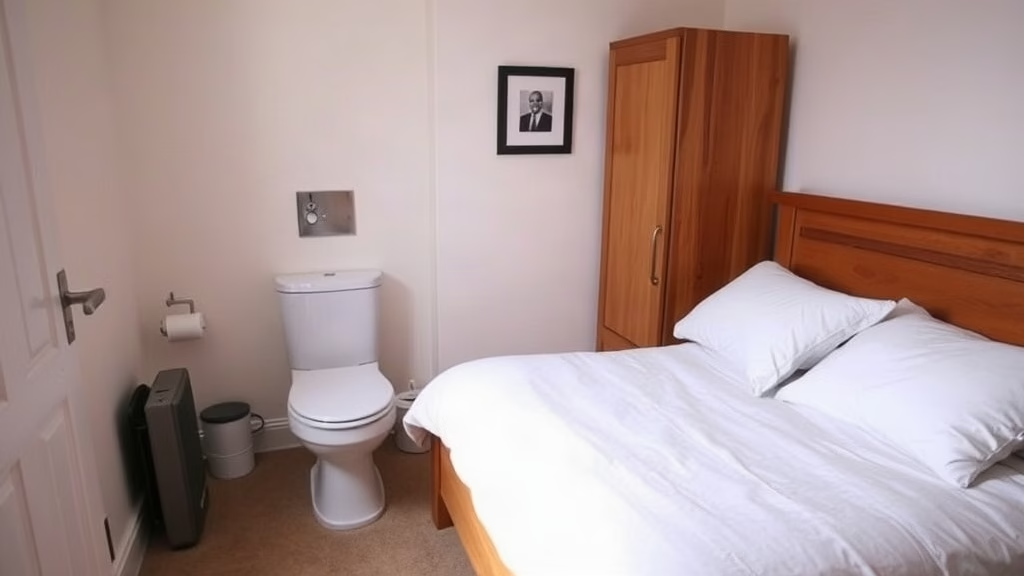
A Manchester resident has reported that his smart home ecosystem now prevents him from accessing his bathroom between the hours of 11pm and 6am without first completing a series of authentication protocols across multiple platforms.
James Whitmore, 34, began his smart home journey in 2021 with a single voice-activated light bulb. He now owns 47 interconnected devices spanning six incompatible ecosystems, none of which acknowledge the others’ existence.
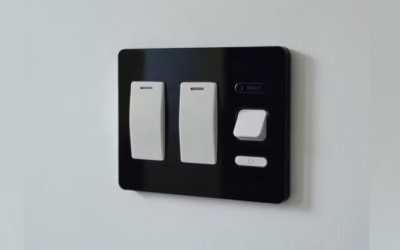
The bathroom issue arose after Whitmore installed a smart lock on his ensuite door to integrate with his morning routine automation. The lock has since decided, for reasons unclear to anyone including its manufacturer, that it reports to the bedroom’s occupancy sensor rather than to Whitmore himself.
“I have to ask Alexa for permission, but Alexa says she needs to check with the SmartThings hub,” Whitmore explained. “SmartThings says the lock’s firmware is out of date. The lock says it updated yesterday. Then my phone asks if I really want to override the bedroom’s sleep optimisation schedule.”
The process currently takes between four and twelve minutes. Whitmore has begun using a bucket.
His kitchen tap now requires a software update before dispensing water above room temperature. His smart doorbell has started recording his arguments with his smart thermostat, which has unilaterally decided that 14°C represents the ideal November temperature and refuses to entertain appeals.
“We’re seeing a lot of homes where the automation has achieved a level of passive-aggressive dysfunction previously only observed in 1970s communes.”
“We’re seeing a lot of homes where the automation has achieved a level of passive-aggressive dysfunction previously only observed in 1970s communes,” said Dr. Helen Cartwright, a researcher at Imperial College London who studies human-computer interaction. “One client reported that his fridge now sends him disappointed notifications when he orders takeaway.”
Whitmore’s bedroom curtains currently open and close according to a schedule he programmed in 2022 and has since forgotten how to access. His smart mirror provides daily affirmations, but only in Dutch following an update in September. His coffee machine has recently started requesting his location data, though it is bolted to his kitchen counter and has never expressed interest in geography before.
The final indignity occurred last Tuesday when Whitmore’s smart mattress detected insufficient REM sleep and remotely locked his car keys in a safe until he agreed to an earlier bedtime. The safe is controlled by an app that requires two-factor authentication and a stable internet connection. His router was updating.
“I just wanted lights I could turn on without getting up,” Whitmore said. “Now I need my home’s approval to eat crisps after 9pm. The toaster knows my weight. Everything knows my weight.”
Marcus Tang, a customer service representative for one of the six companies whose products Whitmore has installed, suggested he try turning everything off and back on again. This resulted in seventeen separate update installations and the permanent loss of his bathroom access credentials.
Whitmore has requested a password reset for his toilet. The email should arrive within five to seven working days.