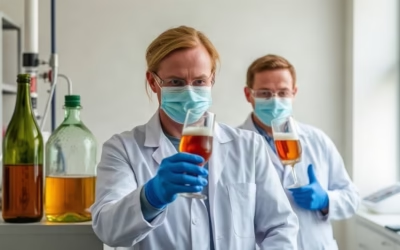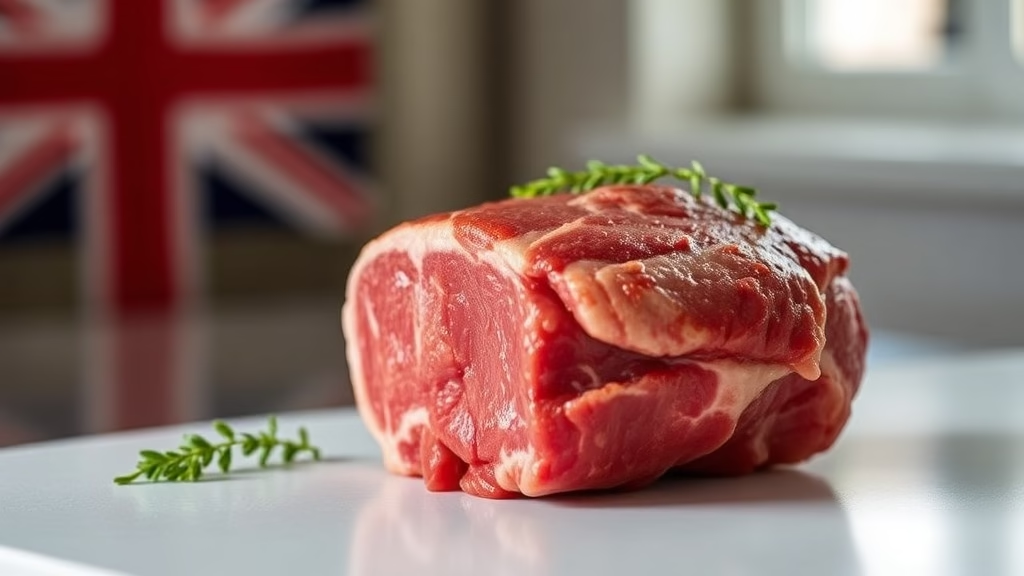
Researchers at the Cambridge Institute for Cellular Agriculture have successfully reduced the overwhelming sense of existential dread previously associated with consuming their lab-grown beef, they announced on Tuesday. The meat now merely suggests a vague melancholy rather than inducing what lead scientist Dr Emma Thornton described as “the full Morrissey experience”.
The breakthrough comes after eighteen months of flavour development. It involved tweaking the nutrient medium used to cultivate muscle cells from bovine stem cells in large steel bioreactors, which Thornton’s team has nicknamed “the sadness vats”.
“We’re really pleased with these results,” Thornton said, standing beside a petri dish containing what appeared to be a small, defeated burger. “Previous iterations were described by taste testers as ‘aggressively beige’ and ‘like eating a divorced man’s kitchen sponge.’ We’ve now achieved something closer to ‘a memory of a Sunday roast your grandmother made in 1987.'”
The study, conducted on forty-three volunteers, measured both flavour profiles and emotional responses. Thirty-one participants reported the meat tasted “fine, I suppose”. Seven said it made them want to lie down. The remaining five requested regular beef, were denied, and did not return for day two of testing.
Researchers initially believed they had solved the palatability problem last autumn. That batch was later found to have been accidentally contaminated with Marmite, which several team members had been eating for lunch near the cell cultures.
“That was a dark period,” admitted Dr James Pemberton, the institute’s head of tissue engineering. “The Marmite variant actually tasted worse than our control samples, which we hadn’t thought possible. It had notes of regret and, inexplicably, dental surgery.”
The current formulation uses a proprietary blend of amino acids, vitamins, and what Pemberton would only describe as “a confidence we don’t entirely feel”. When grilled, the meat produces an aroma that focus groups characterised as “not actively hostile” and “the colour of a February sky”.
The research has received £2.3 million in government funding as part of the UK’s alternative protein strategy. Environment Minister Rebecca Hartley called the progress “encouraging, albeit in a rather qualified sense”.
Thornton remains optimistic about future improvements. Her team is now working on a chicken variant, though early samples have been described by lab technicians as tasting “like giving up” and “a Tesco Metro at 9pm on a Wednesday”.
“We’ll get there,” Thornton said, prodding a grey patty with a plastic fork. “Perhaps not to ‘good,’ but certainly to ‘tolerable under the right socioeconomic conditions.'”
The cultured meat is expected to reach UK supermarkets by 2027, assuming anyone can be persuaded to buy it.