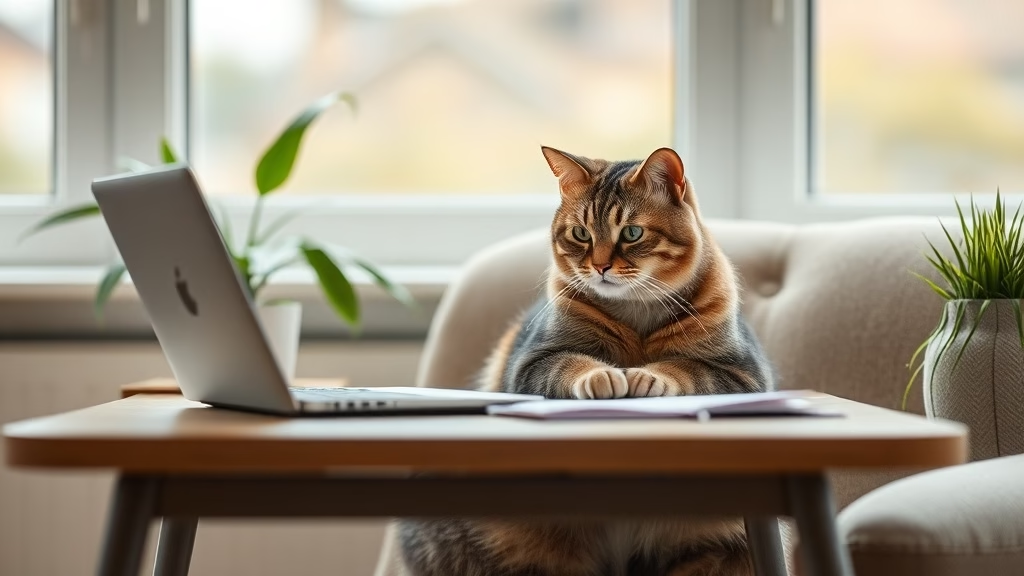
As the nation’s employers continue their protracted negotiations over flexible working arrangements, Britain’s domestic cat population has quietly pointed out that they have been operating a fully remote model since approximately 2019 with no discernible impact on productivity metrics.
The feline workforce, estimated at around 11 million individuals, says it transitioned seamlessly to home-based operations years before the pandemic made such arrangements fashionable. Most report spending between 16 and 18 hours per day in what they describe as deep focus time, during which they remain consistently unavailable for collaborative work or status updates.
Jennifer Morris, a three-year-old tabby from Nottingham, explained that her working day typically begins around 4am with what she terms a standup meeting, conducted at volume near her line manager’s bedroom door. She then blocks out her calendar until early evening.
“I’ve found that setting clear boundaries has been absolutely key to maintaining work-life balance,” Morris said. “If someone tries to schedule a synchronous meeting during my core hours, which are 9am to 5pm, I simply relocate to a different room and become uncontactable. It’s about managing expectations.”
The cats maintain that their approach to remote work has always centred on outcome-driven performance rather than presenteeism. When pressed on what those outcomes might be, most cited successful completion of bathroom breaks, regular circuit testing of the kitchen perimeter, and strategic repositioning in response to sunlight patterns.
Technical difficulties appear to be a recurring challenge. Malcolm Henderson, a four-year-old ginger tom from Bristol, reports that his workspace becomes unsuitable for productivity at least twice daily, typically requiring immediate human intervention to restore functionality.
“The litter tray situation is an ongoing infrastructure issue,” Henderson acknowledged. “I’ve submitted numerous tickets but response times remain inconsistent. It’s impossible to deliver against KPIs when basic facilities aren’t maintained.”
Industry observers note that cats have also pioneered several workplace wellbeing initiatives, including mandatory napping protocols, rejection of arbitrary scheduling constraints, and a firm commitment to switching off completely by pretending not to hear their names being called.
Research suggests the average cat spends roughly 70 per cent of each working day asleep, 20 per cent staring at walls in what appears to be deep strategic thinking, and 10 per cent in urgent cross-functional meetings that involve running at considerable speed to a different floor of the house for no documented reason.
Sarah Pemberton, a behavioural consultant from Manchester who shares her home with two cats, said she had noticed no change in their output over the past five years.
“They’ve always been remarkably consistent,” Pemberton observed. “Which is to say they’ve done absolutely nothing, but they’ve done it with tremendous confidence and an unwavering belief that they deserve compensation regardless.”
The cats have indicated they have no intention of returning to any form of office-based arrangement and will be treating any such suggestion as constructive dismissal.