Trundlewick Group, a mid-sized firm with roughly 900 employees and a car park internally described as ‘adequate’, confirmed on Tuesday that its sustainability commitments remain fully intact and are currently being kept in a drawer.
The drawer, which is in a filing cabinet on the second floor, contains a net zero roadmap, a biodiversity pledge and a supplier code of conduct that was last opened during a fire drill. Staff have been assured that everything in it is in good health, and that it will be taken out again once conditions are suitable, a word the company declined to define.
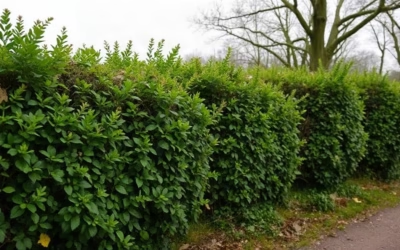
The sustainability page on the Trundlewick website, previously a sprawling affair of targets, infographics and a stock photograph of a child holding a seedling, has been replaced with a photograph of a hedge. There is no caption. Visitors who click on the hedge are taken back to the hedge.
Carolyn Pettifer, Trundlewick’s Director of Corporate Communications, said the change reflected a shift in emphasis and not in substance. ‘We are not backing away from anything,’ she said. ‘We have simply stopped describing it.’ Asked whether that was not, in practice, the same thing as backing away, she said the distinction was important and that she would prefer not to go into it.
A role, rebranded
The company’s Head of ESG has been renamed Head of Things, a title that Graham Oakes, who holds it, said had been chosen after a working group met four times. His duties are unchanged, although the acronym has been removed from his email signature, his door and, at his own request, his LinkedIn profile.
‘I do the same work I always did,’ said Oakes. ‘It’s just that when people ask what I do, I now say things, and they nod, and we both move on with our afternoons.’
The annual report, which last year ran to 84 pages and included a section on Scope 3 emissions that three people are known to have read, now contains a single relevant sentence: ‘We are doing our bit.’ The report does not specify which bit. Pettifer said the bit was ongoing.
The regulatory backdrop
Trundlewick is one of a growing number of businesses to have adopted what analysts call greenhushing, the practice of quietly ceasing to publicise climate targets and sustainability credentials. The trend is generally attributed to two causes: the Competition and Markets Authority’s Green Claims Code, together with its new power to fine companies directly and in sums a finance director can picture, and a wider public mood in which any corporate pledge is met with the sort of look normally reserved for a man selling watches from a coat.
An internal legal memo seen by no one, but described by Pettifer as ‘thorough’, is understood to have concluded that a claim which is never made cannot be misleading. The memo was itself kept in the drawer.
‘It is technically progress, in that the lying has stopped.’ Ruth Aldous, senior policy adviser, DEFRA
Aldous, who sighed audibly before and after giving the remark, said the government had long hoped that companies would become more honest about their environmental performance. ‘I had rather imagined that honesty would involve saying what they were doing,’ she said. ‘Not a hedge. But one takes what one can get in this job, and generally it is a hedge.’
On the ground, the effects have been modest. The three recycling bins in the Trundlewick canteen remain in place, though their labels have been removed and they are now marked A, B and C. Derek Whitlock, the facilities manager, said nobody was entirely sure which was which, but that the intent was there.
The photograph of the hedge, according to the company’s image library, was taken in an unspecified location on an unspecified date and is licensed for unlimited use. Trundlewick has said it is very proud of it.