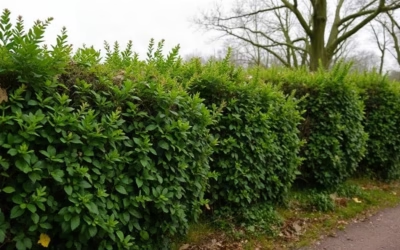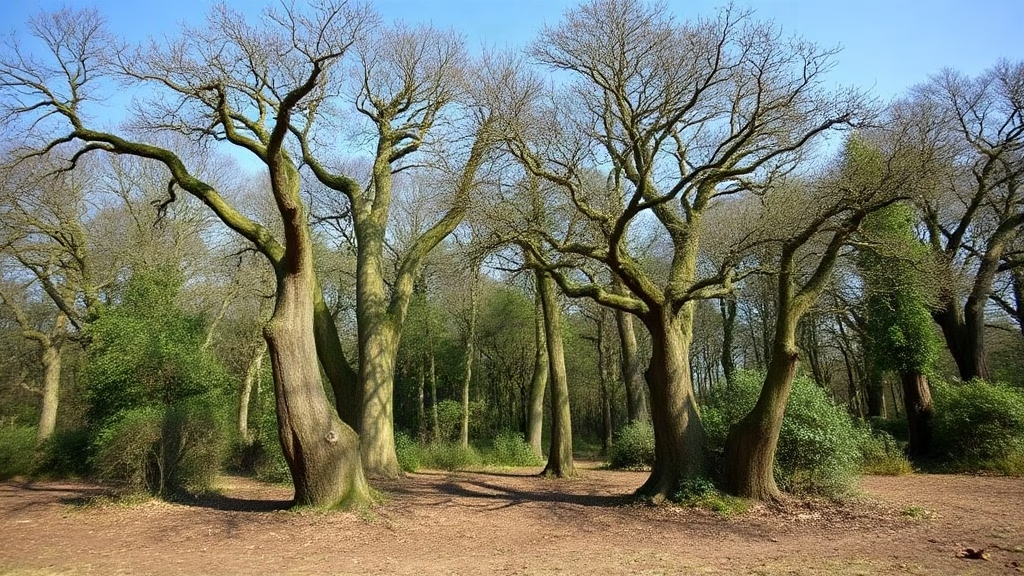
The sole surviving woodland project still registered with Britain’s Carbon Offset Verification Scheme has been revealed to consist primarily of diseased ash saplings in a waterlogged field seven miles outside Mansfield, despite appearing in the net-zero commitments of three major airlines and a crisp manufacturer.
Greenwood Future Forest, a 4.3-hectare site purchased in 2019 with funding from several corporate sustainability programmes, was intended to sequester approximately 847 tonnes of carbon over a thirty-year period. Site inspections carried out last month found 73 per cent of the original plantings either dead or exhibiting advanced symptoms of ash dieback, with the remainder described in the assessor’s report as ‘holding on, but only just’.
The woodland features in offsetting pledges made by TransAtlantic Airways, Northern Budget Air, Executive Jet Solutions, and Premium Snacks Ltd, all of whom paid between £34,000 and £180,000 for credits linked to the site. None of the companies had visited the location. Two were unaware it was in Nottinghamshire.
“We conducted our due diligence through the scheme’s online portal, which showed a photograph of some trees,” said Martin Hewson, sustainability director at TransAtlantic Airways. “The trees in the photograph looked reasonably healthy. We had no reason to suspect they were already dying or that the photograph may have been taken somewhere else entirely.”
The original planting took place during an unseasonably wet March, with several volunteers later reporting that they had been ‘basically pushing saplings into standing water’. The site’s soil drainage assessment, required under forestry regulations, was completed five months after planting had finished. It concluded that the land was ‘questionable for forestry purposes’.
Greenwood Future Forest is now the only active project remaining under the COVS following the quiet dissolution of seventeen other schemes over the past two years. Previous investigations found that offsetting credits had been sold for a community orchard that consisted of three apple trees behind a GP surgery in Swindon, a rewilding project that turned out to be someone’s overgrown garden in Llanelli, and a 40-hectare mixed woodland in Aberdeenshire that auditors could not definitively prove had ever existed.
“The sector has faced some challenges around verification,” said Jennifer Oakes, director of the COVS, speaking from an office that is, at least, definitely real. “We’re implementing new site visit protocols, though obviously we’re somewhat constrained by budget. The important thing is that corporate partners are engaging with their carbon reduction journey in a meaningful way.”
TransAtlantic Airways has announced it remains committed to achieving net-zero by 2045, and is currently exploring alternative offset opportunities. The airline’s annual report notes it is in discussions about a kelp regeneration programme off the coast of Cornwall, though preliminary surveys suggest the proposed site is largely sand.