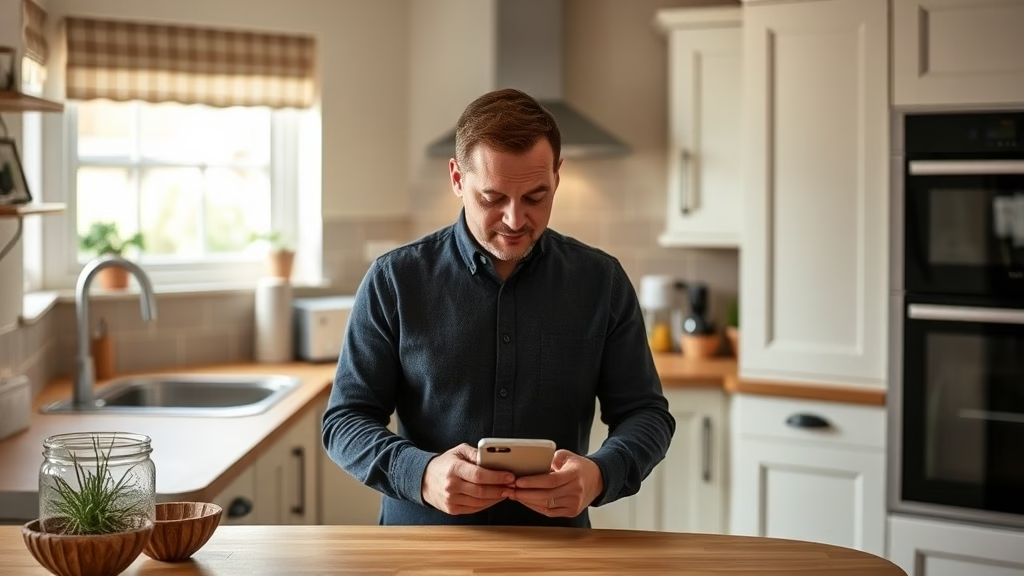
A software developer from Bristol has confirmed that his investment in seventeen smart home devices has successfully transformed him into an unpaid IT support technician for his own kettle.
James Hartley, 34, purchased the devices over eighteen months after watching a YouTube video titled “The Connected Home of Tomorrow”. Tomorrow has arrived. It does not work.
The problems began when his Philips Hue lights refused to acknowledge the existence of his Samsung SmartThings hub, despite both supporting the Matter standard supposedly designed to prevent exactly this situation. His kitchen now operates on a timezone three hours behind the rest of the house. His bathroom believes it is permanently 2am. His living room has achieved sentience but only uses it to disconnect from WiFi every forty minutes.
“I spent twelve minutes this morning explaining to my coffee maker that it was, in fact, Wednesday,” Hartley said. “It insisted on Tuesday. We compromised on Thursday. Now it won’t heat water above sixty degrees because that’s apparently not a valid day for hot beverages.”
The Matter standard, released in 2022 with promises to unite the fractured smart home ecosystem, currently connects his devices in the sense that they are all equally confused about what time it is. Five require separate apps. Three of those apps have not been updated since 2021. One was made by a company that no longer exists.
Hartley’s refrigerator sends him notifications about items that expired in other people’s fridges. His smart doorbell records video exclusively of next door’s bins. His thermostat has strong opinions about the temperature but implements none of them.
“The real breakthrough came when I added a smart plug,” he said. “It’s just a plug. Turns things on and off. Took forty minutes to connect and now controls a lamp in someone’s house in Swindon. I know this because they keep turning it off during my Zoom calls.”
Dr. Eleanor Preston, a researcher in human-computer interaction at Imperial College London, said the situation was “regrettably typical”. Her own study of smart home adoption found that 67% of users spent more time managing their devices than the devices saved them. The study was conducted on nineteen participants, four of whom had given up entirely and now just use light switches like animals.
“We’ve created a system where your toaster needs a software update,” Preston said. “Nobody asked for this. The toaster certainly didn’t.”
Hartley estimates he now spends six hours weekly troubleshooting device conflicts, updating firmware, and explaining to various household objects what country they are in. He previously spent this time seeing friends.
His partner moved out in February, citing “philosophical differences about whether a bin should have an IP address”. The smart lock he installed to secure the flat after her departure has since forgotten its own password. He now enters through the window.
When asked if he regretted the purchases, Hartley paused. His voice-activated assistant, unprompted, began playing whale sounds. It continued for three minutes. He no longer knows which device is responsible.
“I just wanted the lights to turn on when I came home,” he said.
They do not.