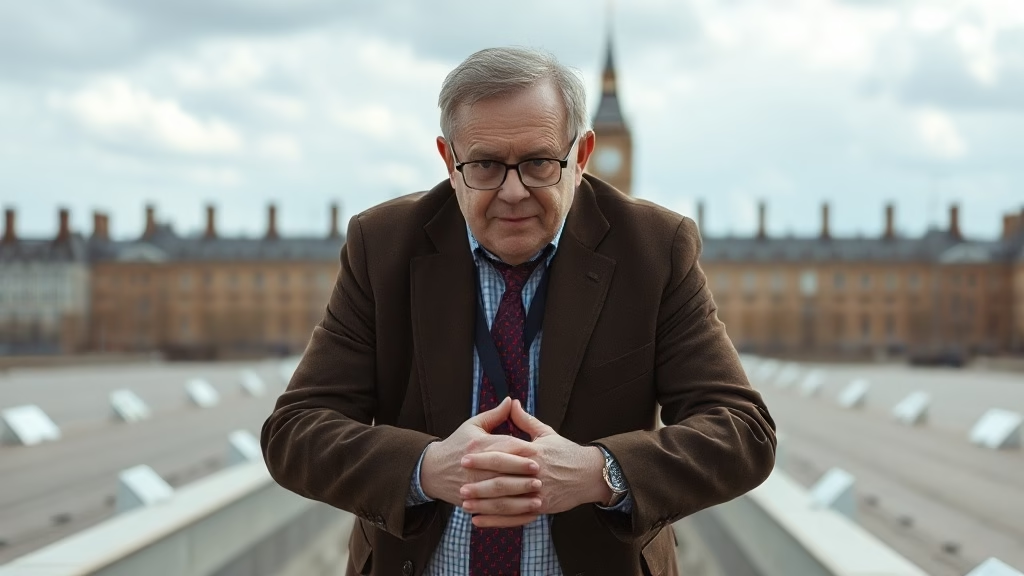
Professor Michael Hendry, the sole quantum physicist left in Britain after the others emigrated or retrained as plumbers, has admitted he hasn’t got a clue what’s actually happening at the quantum level either.
The confession came during a government press conference intended to celebrate £2.4 billion in funding for UK quantum computing hubs. Hendry had been explaining superposition to a room of journalists for eleven minutes when he stopped mid-sentence, removed his glasses, and said: “Look, I can do the equations. The numbers work. But if you’re asking me what’s genuinely occurring, I’m as baffled as you are.”
The room sat in silence. One journalist from the Financial Times began to cry.
Hendry, who holds the Feynman Chair in Theoretical Physics at Imperial College London, says he’s been “winging it” since his PhD viva in 2003. “The examiners kept nodding when I said particles could be in two places at once, so I assumed they understood it,” he explained. “Turns out they were just as confused but didn’t want to look stupid in front of each other.”
The revelation has plunged Britain’s quantum computing sector into crisis. Three government ministers have tendered their resignations. A spokesman for the Department for Science, Innovation and Technology said the department would be “reviewing its investment strategy” before adding, “What even is entanglement? Seriously, can someone tell us?”
Hendry’s moment of honesty was apparently triggered by a question from BBC Science Editor Rebecca Watts, who asked him to explain how quantum computers could theoretically break encryption. “I was about to launch into the usual thing about qubits existing in multiple states simultaneously,” Hendry said, “when I suddenly thought: that’s absolutely mental, isn’t it? How would that work? Why would that work? I’ve no earthly idea.”
He continued: “I can tell you the wave function collapses upon measurement. I can show you the Schrödinger equation. I cannot tell you why observing something changes it. That’s insane. That shouldn’t happen. But it does, and we’ve all just been pretending it makes sense for a century.”
“The examiners kept nodding when I said particles could be in two places at once, so I assumed they understood it. Turns out they were just as confused.”
Dr. Helen Pritchard, a former quantum researcher who now runs a garden centre in Dorset, says she’s relieved someone finally said it. “We’d have these conferences where everyone would present papers using phrases like ‘non-local correlation’ and ‘quantum tunnelling’,” she said. “Then we’d go to the pub and quietly admit none of it makes any intuitive sense whatsoever. The maths is fine. The reality is bonkers.”
Hendry has proposed a new approach to quantum physics communication. “We should just tell people: the universe runs on rules that sound made up, the equations predict things correctly, and nobody knows why. That’s it. That’s quantum mechanics.”
The government has responded by increasing funding to £3.1 billion, hoping someone will eventually work it out.