Dr Jennifer Hargreaves has spent the past seventeen years working in ecological restoration across the British Isles, a period she describes as “watching people discover that nature does quite well when you simply cannot be arsed any more”. Speaking from her office at the Midlands Biodiversity Centre, surrounded by funding applications that might as well read “please pay us to stop trying”, she outlined the current state of the nation’s rewilding initiatives.
“Look, I’m not saying all rewilding is just agricultural surrender with better branding,” she said, gesturing at a map dotted with sites that have received substantial environmental grants. “But I am saying that about half of it is, and the other half is still under review.”
The interview took place shortly after a 400-acre estate in Northumberland secured £2.3 million in conservation funding, having submitted a detailed proposal that essentially amounted to not cutting the grass for five years. The landowner, whose family has farmed the area since 1847, reportedly wept with relief at being paid to stop doing something he could no longer afford to do anyway.
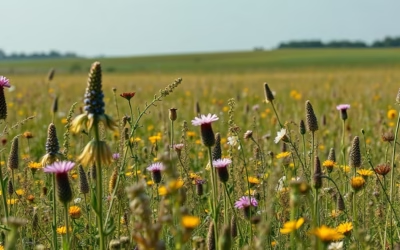
Dr Hargreaves warmed to her theme. “We’ve got sites where the rewilding strategy is literally just removing the cattle and seeing what happens. Which, fine, that’s legitimate ecology. But it’s also what happens to any field when you forget about it for a bit. We’re conducting peer-reviewed studies on neglect.”
She pulled up a funding application from a project in Somerset, where a former industrial site is being marketed as brownfield rewilding. “This is a Tesco car park that closed in 2019,” she noted. “They’ve got £180,000 to monitor the spontaneous vegetation. It’s buddleia and Japanese knotweed. I can tell you that for free.”
The conversation turned to the philosophical question of whether there is any meaningful distinction between rewilding and simply giving up. “Technically, yes,” Dr Hargreaves said, after a long pause. “Rewilding has monitoring requirements and quarterly reports. Giving up is just giving up. Though I’ll be honest, some of the reports I’ve read could go either way.”
Martin Eccleston, a land manager in Cumbria who recently transitioned his 200-acre sheep farm into a rewilding project, defended the approach. “People say I’m just letting the place go to rack and ruin, but I’ve got a biodiversity action plan now,” he said. “It’s different. The brambles are strategic.”
Dr Hargreaves acknowledged that some rewilding projects are genuinely ambitious, involving careful species reintroduction and habitat management. “And some are a bloke in Shropshire who stopped mowing his lawn in 2020 and is now calling it a pollinator meadow on his Instagram,” she added. “Both are receiving roughly the same amount of media coverage, which tells you something about where we are as a society.”
When asked whether she remained optimistic about Britain’s ecological future, Dr Hargreaves said she was cautiously hopeful that nature would recover regardless of whether humans were actively helping or just stepping back because the petrol for the strimmer had got too expensive. “Either way, the beetles are doing alright,” she said.