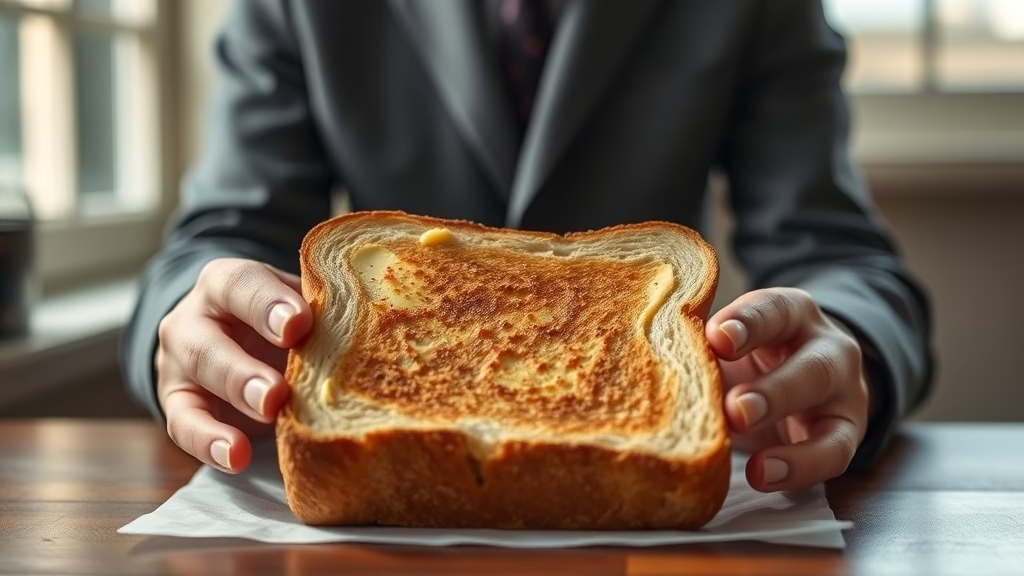
Researchers at the Institute for Applied Breakfast Physics in Swindon have identified a previously unknown subatomic particle that they claim is responsible for toast consistently landing butter-side down when dropped.
The particle, named the “butterino”, was detected after a seventeen-year study involving 847 slices of toast, three industrial-grade accelerators, and what the team describes as “an absolutely punishing amount of Lurpak”.
Dr Helen Carmichael, Professor of Carbohydrate Mechanics at the Institute, announced the findings at a press conference held in the facility’s break room. “The butterino exhibits a negative charge when exposed to dairy-based spreads, creating an attractive force between the coated surface and any floor within a two-metre radius,” she explained. “Margarine produces a weaker effect, which frankly tells you everything you need to know about margarine.”
The research, funded by a £14.3 million grant from the Economic and Social Research Council, required the construction of a specialized detection chamber lined with kitchen lino. Scientists dropped toast from varying heights whilst measuring gravitational pull, air resistance, and what Dr Carmichael termed “the fundamental unfairness of the universe”.
The butterino joins other recently discovered particles in the Standard Model of Household Irritation, including the sockton (responsible for disappearing laundry) and the quark-screw (which causes flatpack furniture to have leftover pieces).
“We observed that white bread produced 340% more butterinos than wholemeal,” said Dr Carmichael. “Sourdough created an entirely different particle we’re calling the smuggion, but that’s outside the scope of this study.”
The team’s methodology involved dropping toast at precise intervals whilst graduate students recorded impact orientation. Two students withdrew from the programme after what their supervisor described as “philosophical differences regarding the definition of ‘lightly toasted'”.
Professor James Wickham, Head of Disappointment Studies at Imperial College London, called the findings “potentially revolutionary, assuming the peer review process doesn’t discover they’ve just rediscovered gravity, which has happened before”.
The Institute plans to investigate whether the butterino effect extends to jam. Initial trials suggest it does, with the added variable of carpet colour influencing splatter patterns.
Dr Carmichael noted that the research has practical applications. “If we can isolate and manipulate butterinos, we might reverse the polarity. Your toast could land butter-side up.” She paused. “Though obviously that means it would land on the ceiling, which presents its own problems.”
The findings will be published in next month’s Journal of Things That Annoy People More Than They Should. The Institute is already fielding calls from cutlery researchers who believe a similar particle explains why teaspoons vanish from office kitchens.
When asked whether £14.3 million represented good value for taxpayers, Dr Carmichael gestured to a flip chart showing butter consumption data. “Science isn’t cheap,” she said. “Also, we’ve got five years of breakfast sorted.”