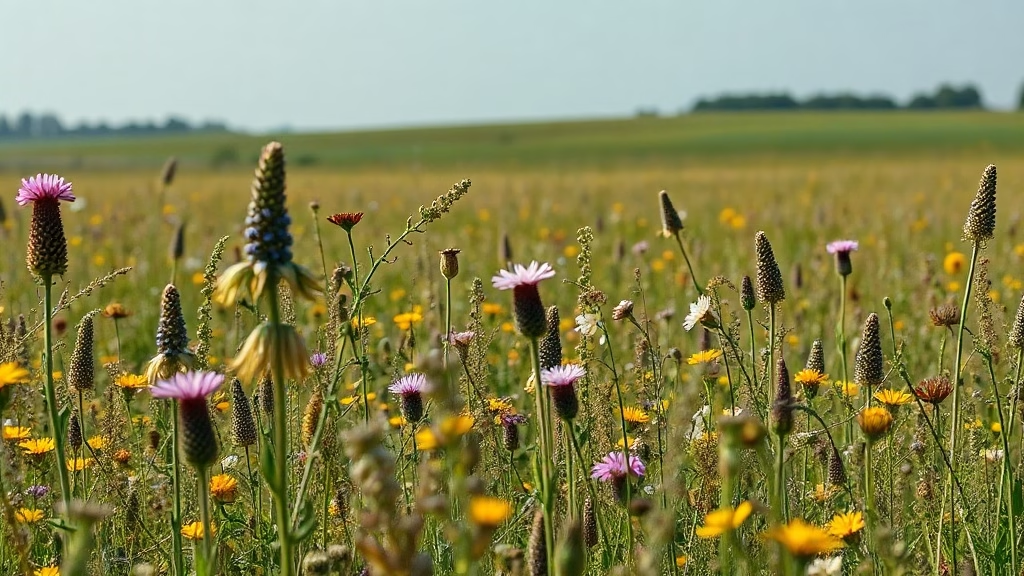
Developers have been granted permission to transform the country’s final surviving ancient wildflower meadow into a 340-space car park featuring what they describe as a ‘pioneering approach to biodiversity enhancement’.
The 47-acre site in Hertfordshire, which has sustained unbroken grassland ecology for approximately 800 years and currently supports 127 plant species including several considered nationally scarce, will be replaced with permeable paving and a 2.8 square metre raised planter containing a curated selection of twelve native wildflower species. The planter will be positioned near the payment machine.
Planning documents submitted by Greenfield Developments Ltd emphasise the project’s commitment to environmental stewardship. The application runs to 340 pages, of which 312 comprise ecological impact assessments concluding that the existing meadow, whilst undeniably present, could be ‘significantly improved’ through what the report terms ‘managed biodiversity infrastructure’.
“We’ve listened carefully to local environmental concerns and incorporated them fully into our vision,” said Martin Hendricks, the company’s sustainability coordinator. “By replacing this somewhat random assemblage of flowers with a carefully designed native species installation, we’re demonstrating that development and nature don’t just coexist. They thrive together, particularly when the nature is in a dedicated receptacle with proper drainage.”
The planter will feature ox-eye daisies, cornflowers, and common poppies, all of which currently grow across the existing meadow in what developers have described as ‘an unstructured and frankly inefficient manner’. The new arrangement will see the flowers organised alphabetically and watered on Tuesdays.
Hertsmere District Council approved the application unanimously following a four-minute discussion in which members acknowledged they were ‘mindful of environmental concerns’ before agreeing that the car park was needed to serve a new retail park built on the site of what was, until last year, the country’s second-to-last ancient wildflower meadow.
“This is exactly the kind of balanced, forward-thinking development our community needs. The addition of sustainable drainage systems and a wildflower feature demonstrates that we can have our car park and our biodiversity too.”
Councillor Patricia Webb, who chairs the planning committee, said the decision reflected the council’s commitment to its ambitious rewilding targets. “This is exactly the kind of balanced, forward-thinking development our community needs,” she said. “The addition of sustainable drainage systems and a wildflower feature demonstrates that we can have our car park and our biodiversity too.”
The twelve wildflower species selected for the planter represent approximately nine per cent of the plant biodiversity currently present on the site. The remaining 115 species have been assessed as ‘not essential to the core wildflower experience’.
Local ecologist Dr James Priestley, who has studied the meadow for thirty years, pointed out that the site contains several orchid species that take decades to establish and cannot simply be relocated to a raised bed near a ticket machine. He was thanked for his input.
Construction is expected to begin in May, which developers note is outside the main bird nesting season, although well within the main wildflower flowering season. The planter will be installed in September.