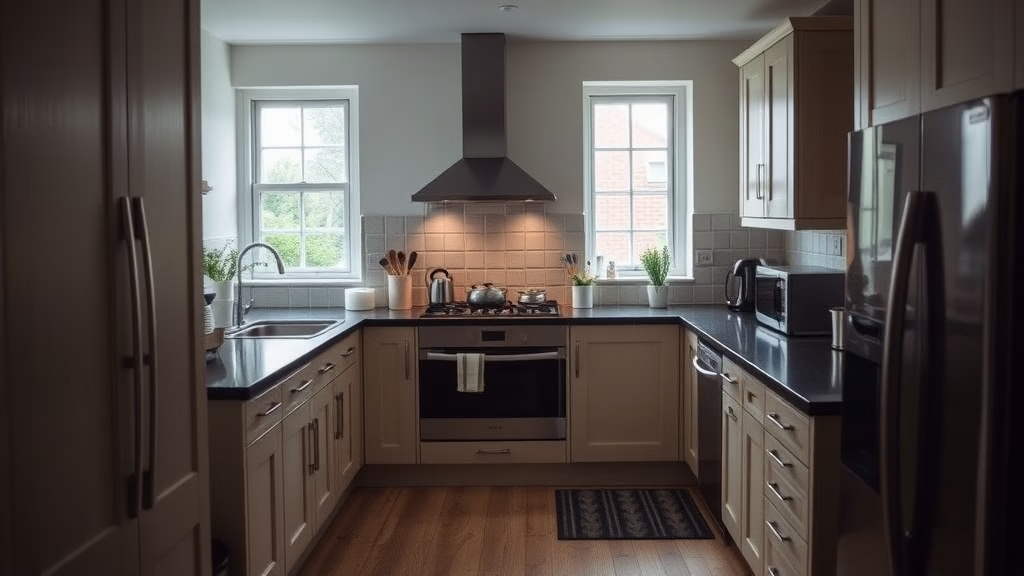
A Berkshire man remains confined to his kitchen after a router malfunction rendered every appliance in his home inoperable, including the smart lock that would allow him to leave the room.
James Weatherall, 34, entered his kitchen at 7.23am on Tuesday to make coffee. His Virgin Media broadband dropped at 7.26am. He has been there ever since.
The kitchen contains a smart fridge that will not open without an internet connection, a voice-activated kettle that has become selectively deaf, and a bin with a motorised lid currently frozen in the closed position. The door handle, which Weatherall upgraded to a Matter-compatible smart lock three weeks ago for £340, requires cloud authentication to operate from either side.
“I thought I heard the router reboot around 2pm,” said Weatherall, speaking through the door to his partner. “Turned out to be the smart toaster updating its firmware. Again. That’s four times this month.”
His partner, Emma Cavendish, confirmed she could simply unlock the door manually from the hallway but that doing so would desynchronise the lock from its app, requiring a full factory reset and re-pairing with their home ecosystem. This process took six hours when they last attempted it in February.
“We’ve agreed it’s easier to wait for Virgin Media,” she said. The customer service representative told her to expect an engineer sometime between now and Friday.
Weatherall’s kitchen operates on three separate apps, two proprietary hubs, and what the installation manual described as “seamless integration with 147 compatible platforms.” On Monday, all of these systems worked perfectly to dim the lights by 3% when he said the word “relax.” On Tuesday, none of them could operate a door.
“The irony is I’ve got a smart water tap in here,” Weatherall added. “So I’m staying hydrated. It’s just that the water comes out at precisely 96 degrees because that’s what I programmed for tea, and I can’t access the app to change it.”
Dr Linda Hewson, a researcher in human-computer interaction at UCL, said this scenario was increasingly common. “We’ve essentially recreated the experience of being trapped in a Victorian pantry, but with more LEDs,” she explained. “The Victorians just had a broken door handle. We have seventeen different systems that all need to agree you’re allowed to touch the handle, and they communicate via a server in Ohio.”
Her department recently studied smart home reliability across forty households. Thirty-two experienced at least one lockout event per month. Five participants had given up entirely and removed the batteries from everything, rendering their £3,000 investment into what one described as “very expensive normal objects.”
Weatherall reports he has now eaten four cereal bars from the emergency drawer, the only storage unit in the kitchen without electronic assistance. He briefly considered forcing the fridge but noted it would void the warranty. The fridge cost £1,850.
Virgin Media’s automated system continues to insist his internet is working perfectly.