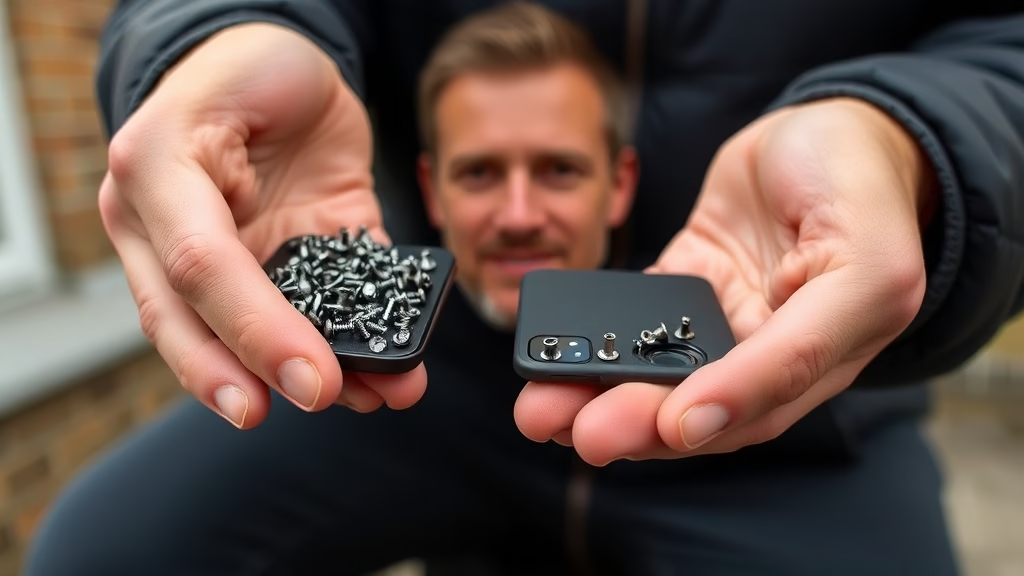
Tom Hargreaves, 34, has confirmed that his ethically sourced, modular smartphone is technically still under warranty, though he voided it somewhere around step 23 of a 47-step battery replacement guide.
The Bristol-based graphic designer purchased the device in September after reading several articles about the right-to-repair movement and the EU’s bold new stance on planned obsolescence. He has since acquired four specialized screwdrivers, a plastic spudger he cannot identify by touch alone, and a Tupperware container holding nine screws that may or may not be load-bearing.
“The website said it was designed to be repaired with a standard Phillips head,” Hargreaves explained, gesturing to the five different screwdriver bits scattered across his kitchen table. “Turns out there are apparently seventeen types of Phillips head. I’ve got three of them. None of them are the right one.”
The battery issue emerged six months after purchase, when the phone began dying at 34% charge. The manufacturer’s website featured a cheerful video of a woman replacing the component in under three minutes. She did not drop any screws into her sofa. She did not accidentally disconnect the display ribbon cable. Her hands were, Hargreaves noted, “suspiciously steady, like a surgeon’s, or someone who hasn’t had coffee yet.”
The replacement battery cost £42. The toolkit cost £28. The second replacement battery, ordered after Hargreaves punctured the first one with a screwdriver whilst attempting to prise it from its adhesive mounting, cost another £42.
“I think the real issue is that the guide assumes you can see what you’re doing,” said Jennifer Okoye, an optometrist from Manchester who recently treated herself to a £180 magnifying lamp specifically for phone repairs. “It’s described as ‘gently lift the connector.’ There are four connectors. They’re all black. The tweezers are too big. My fingers are too big. Everything is too big except the screws, which are too small.”
Okoye’s phone currently works, though she has not ruled out the possibility that she reassembled it with components from her old Kindle, which stopped working around the same time.
The right-to-repair movement has celebrated several recent victories, including new EU regulations requiring manufacturers to make spare parts available for up to ten years. The regulations do not require manufacturers to make the spare parts distinguishable from one another under standard household lighting, nor do they mandate that step 31 of any repair guide should not be “carefully note the position of the six adhesive strips before removing.”
Hargreaves confirmed that his phone is now working again. He is uncertain which of his three repair attempts actually fixed it. The Tupperware container of mystery screws sits in his desk drawer, alongside an iPhone cable and some Sellotape.
“I’m keeping them in case I need them,” he said. “I will never need them.”