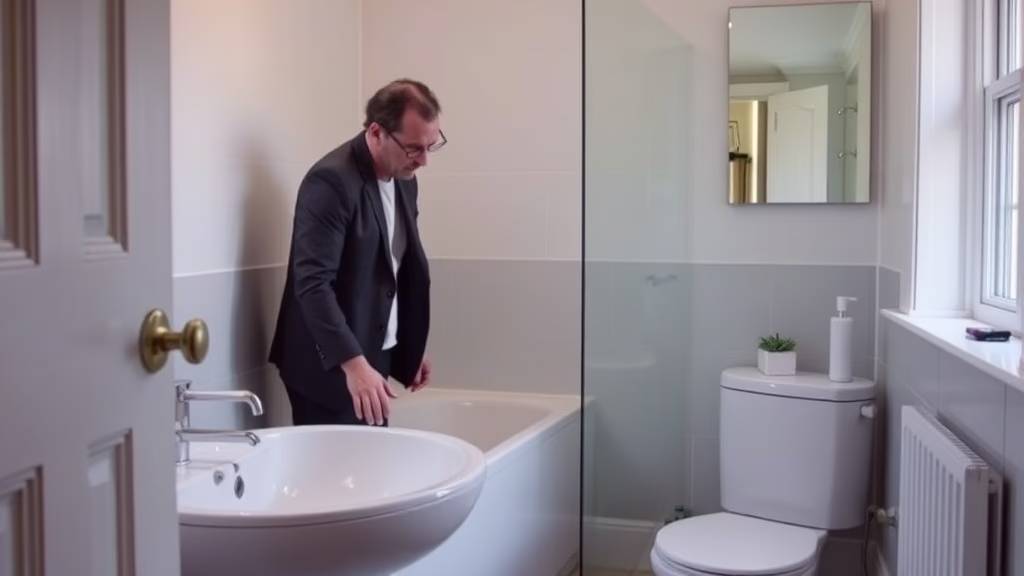
A Chelmsford man who has invested £2,400 in smart home technology over the past eighteen months is still required to physically walk three metres to operate his bathroom light switch.
James Thornton, 34, can currently adjust his bedroom temperature from a beach in Málaga, dim his living room lights via voice command, and receive notifications when his fridge door has been open for more than thirty seconds. He cannot, however, turn on the bathroom light without getting up.
The issue stems from what Thornton describes as “a compatibility situation.” His bathroom smart bulb operates on the Zigbee protocol. His primary smart home hub only supports Z-Wave and Wi-Fi devices. A secondary bridge device that would resolve this costs £89 and is currently out of stock until March.
“I can ask Alexa to play Radio 4 in the kitchen, Google to set a timer in the office, and Siri to lock the front door,” Thornton explained. “But those three don’t talk to each other, and none of them talk to the bathroom.”
Thornton’s smart home ecosystem currently comprises devices across seven different platforms. Four require separate apps. Two of those apps haven’t been updated since 2022. One company no longer exists, though its smart plugs continue to function with what Thornton calls “an eerie autonomy.”
The Matter standard, introduced in 2022 to solve precisely this problem, theoretically makes all devices interoperable. In practice, Thornton owns fourteen smart home devices. Three are Matter compatible. None of them are in the same room.
“I thought Matter would fix everything,” said Thornton. “Then I read the specification document. It’s 1,400 pages long.”
Dr Rebecca Walsh, a technology researcher at the University of Sussex, says Thornton’s situation is increasingly common. “We’re seeing consumers invest significant money in creating homes that are objectively less convenient than they were in 1987,” she noted. “One participant in our recent study had six remotes for his television but couldn’t turn off his smart kettle without consulting a YouTube tutorial.”
Thornton has attempted various solutions. He purchased a hub that promised to unify all platforms. It unified five of them. He factory reset his devices and started fresh. This took eleven hours and resulted in his heating thinking it was in Chicago for three days.
His bathroom light, meanwhile, remains resolutely analog.
“The switch works perfectly,” Thornton conceded. “You just flip it. Up for on, down for off. It’s never failed once.”
He has considered buying a £140 compatible hub specifically for the bathroom light. He has also considered just buying a normal bulb for £3.50.
“But then the bathroom wouldn’t be smart,” he said. “And I’ve come too far for that.”
At press time, Thornton was attempting to explain to Alexa that “bathroom” and “bath room” are the same thing.