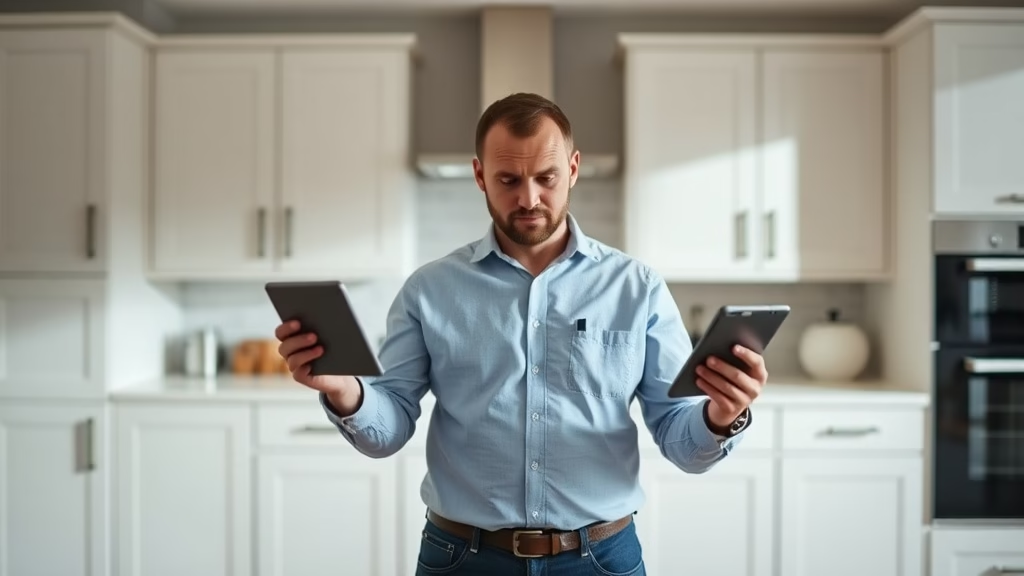
A Nottingham man has revealed that his journey towards a fully automated home has instead resulted in a domestic environment that requires more human intervention than a Victorian workhouse.
Martin Fowler, 42, began installing smart devices in his three-bedroom semi in 2019. He now owns 47 connected products across eight different ecosystems. None of them speak to each other.
“The dream was that I’d walk in and say ‘I’m home’ and the lights would come on, the heating would adjust, maybe some jazz would play,” said Fowler, a project manager who has stopped mentioning what kind of projects he manages. “The reality is I stand in the dark hallway for six minutes waiting for my Philips Hue bridge to reconnect whilst my Google Home tells me it doesn’t recognise my voice.”
Fowler’s kitchen alone contains devices from four manufacturers. His lights run on Hue. His thermostat is Nest. His door sensor is from a company that no longer exists but still sends him firmware update notifications. His bin, inexplicably, has an app.
The introduction of Matter, a universal smart home standard backed by every major tech company, was supposed to solve these issues. It has not solved these issues.
“Matter compatible means absolutely nothing,” said Dr Elena Mitchell, a technology researcher at Imperial College London who recently went back to using light switches. “What it actually means is that your device might work with some features of some platforms if you perform a factory reset on the third Wednesday of the month whilst holding your phone at a 47-degree angle.”
Fowler’s morning routine now involves checking three separate apps before he can make coffee. His coffee machine is smart. It needs a software update. It has needed a software update for six weeks. The update file is 340MB. Nobody knows why.
“I bought an Amazon Echo, a Google Nest Hub, and an Apple HomePod because I was told they’d all work together,” Fowler explained, gesturing at the trio of devices arranged on his counter like a failed tech nativity scene. “They don’t work together. They barely work alone. Mostly they just light up and say they didn’t catch that.”
The breaking point came last Tuesday when Fowler spent 45 minutes trying to turn off his bedroom lamp. The lamp, which cost £89, required him to update its companion app, restart his router, and eventually create a new account because the servers didn’t recognise his email address. The email address he’d been using for three years.
“My wife has started keeping a torch by the bed,” said Fowler. “It’s one of those wind-up ones. No batteries, no apps, no bridge device. It’s absolutely brilliant. Cost her seven quid.”
A spokesperson for the Connectivity Standards Alliance, the body behind Matter, said the standard was “rolling out successfully” and that “teething problems were to be expected.” The spokesperson declined to comment on whether their own home used smart devices. Sources suggest they have a Nest thermostat which they control manually.
Fowler says he’s now considering selling up and starting again. Or possibly just buying some normal light switches.
His smart doorbell, which he installed to see who was at the door, currently shows him a live feed from three days ago.