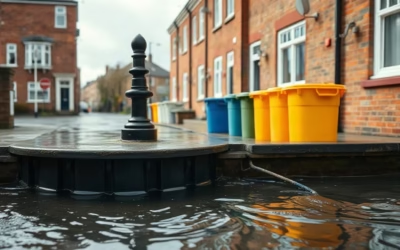
The Department for Environment, Food and Rural Affairs has announced that all household recycling bins across England will be fitted with surveillance cameras by April 2025, following what officials described as a “minor gap in our understanding” of where approximately 3.7 million tonnes of sorted plastic actually ends up each year.
The cameras, manufactured by a subsidiary of Serco at a cost of £847 per household, will allow residents to track their yoghurt pots and milk bottles on a dedicated smartphone app as the items make their journey from kerbside collection through to what the government hopes will eventually be identified as their final destination.
Environment Secretary Martin Yates defended the scheme at a press conference held in front of a banner reading “Britain Recycles”, which appeared to be made from non-recyclable vinyl. “British families have shown tremendous dedication to rinsing out their mayonnaise jars and removing the little plastic windows from envelopes,” he said. “They deserve to know whether that effort results in their waste being responsibly reprocessed in a facility in Swindon or simply filmed being set on fire behind a warehouse in Malaysia.”
The announcement comes three weeks after a Freedom of Information request revealed that the government’s official waste tracking system has consisted primarily of a series of enthusiastic assumptions and a single Excel spreadsheet last updated in 2019.
Under the new system, households will receive real-time notifications when their recycling is collected, sorted, baled, shipped, and either genuinely recycled or deposited in what the app’s beta version currently labels as “various outdoor locations in Southeast Asia”. A pilot scheme in Wolverhampton has already enabled 40,000 residents to watch their carefully separated plastics join an enormous pile in a field in Turkey, though the app crashed when too many users tried to access the live stream simultaneously.
Rachel Donnelly, head of waste services at Sheffield City Council, said the technology would not address underlying questions about her department’s actual recycling contracts. “We’re very excited about the cameras,” she said. “They’ll give residents unprecedented visibility into the complicated journey their waste takes, right up until the signal cuts out somewhere over the Mediterranean. Beyond that point I’m sure everything is absolutely fine.”
The government has dismissed concerns that the scheme represents a disproportionate response to what is essentially an administrative failure to maintain proper waste management oversight. Officials pointed out that British households have long accepted surveillance as a reasonable price for the theoretical possibility of functional public services, and that most people are already filmed an average of 70 times per day anyway.
The recycling cameras will join existing CCTV networks monitoring town centres, car parks, buses, trains, parks, and the interiors of some public bins, creating what the Home Office describes as “a comprehensive visual record of British life, minus the bits we’ve lost the footage for”.
Households will still be required to separate their waste into the correct colour-coded bins, rinse all containers, and remove all film and labels. The government confirmed that putting the wrong type of plastic in the wrong bin will remain a criminal offence, regardless of where that plastic ultimately ends up.