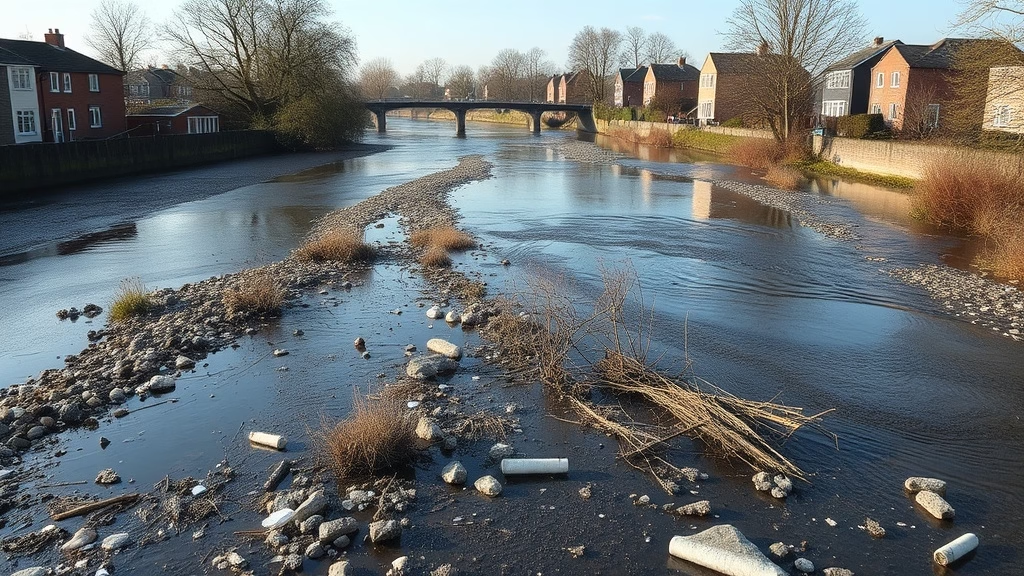
Thames Valley Water has announced that its ongoing commitment to depositing untreated sewage into local waterways has successfully transformed the River Kennet into what it describes as a ‘pioneering bioenergy asset with significant carbon-neutral potential’.
The announcement, made during the company’s quarterly results presentation, comes as the Environment Agency confirmed that dissolved oxygen levels in the river have reached what one scientist called ‘impressively catastrophic’ concentrations. Thames Valley Water, however, prefers the term ‘methane-rich aquatic environment’.
Chief Executive Martin Hendricks told shareholders that the company’s £2.8 billion infrastructure investment programme, which has so far consisted entirely of discharging raw sewage through forty-three separate outflows, should be viewed as ‘future-focused renewable energy preparation’ rather than what he acknowledged some might see as ‘a sustained and criminal assault on the natural environment’.
The company’s latest sustainability report runs to 247 pages, with an entire chapter devoted to explaining how human waste, when introduced to river systems in sufficient volume, creates what it calls a ‘closed-loop biomass generation cycle’. The fact that this cycle also kills everything that lives in the river is addressed in a footnote on page 186, where it is described as ‘legacy ecosystem transition’.
We are essentially creating liquid composting facilities at scale, which positions us as environmental innovators rather than the ecological vandals certain activist groups persist in calling us.
Dr Jennifer Walters, Thames Valley Water’s newly appointed Director of Environmental Narrative, said the company had been ‘unfairly maligned’ for its forward-thinking approach to waste management. She pointed out that the company’s sewage discharge programme has reduced the operational costs of traditional treatment plants by 94 per cent, generating savings that have been ‘strategically reinvested’ in executive compensation packages and dividends for overseas shareholders.
The press release notes that several rivers in the Thames Valley Water service area now contain such high concentrations of phosphates, nitrates and faecal matter that they have achieved what the company calls ‘post-river status’, a designation it hopes will be formally recognised by the Department for Energy Security and Net Zero. The company has submitted a proposal suggesting these post-river entities should qualify for the same renewable energy subsidies currently available to wind and solar projects.
When asked whether turning rivers into open sewers might conflict with the company’s stated environmental commitments, Hendricks said the question reflected a ‘dated understanding of sustainability’. He added that Thames Valley Water’s forward-thinking approach has already attracted interest from water companies across England, all of whom are keen to rebrand their own pollution scandals as ‘renewable infrastructure transitioning’.
The company’s share price rose 3 per cent following the announcement. The River Kennet continues to smell like a chemical toilet that has achieved sentience.