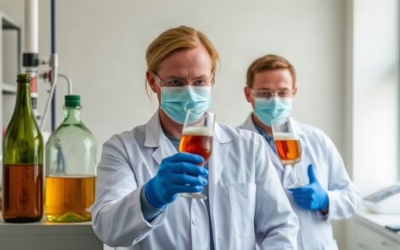
Britain’s leading quantum physicists have admitted that despite possessing equipment capable of detecting individual photons, they remain completely unable to identify the source of the weird smell in Lab 3B.
The confession comes amid celebrations of a major breakthrough in quantum sensing technology, which allows researchers to measure previously undetectable phenomena with unprecedented precision. The same technology has proven useless in locating whatever has been causing that vaguely organic odour near the fume cupboard since February.
“We can now observe quantum states that collapse in billionths of a second,” said Dr Helen Pritchard, lead researcher at the Cambridge Quantum Sensing Initiative. “But we’ve absolutely no clue if that smell is old food, a dead mouse, or just what happens when you leave the same lab coat on a peg for three years.”
The laboratory in question houses equipment worth approximately £4.2 million. It also houses a microwave from 1987, a fridge containing samples that predate two of the current PhD students, and at least one mug that has evolved its own ecosystem.
Scientists initially suspected the odour originated from a forgotten sandwich. An investigation ruled this out after discovering seven forgotten sandwiches, none of which matched the smell’s particular notes of decay and electrical burning.
“People imagine these gleaming facilities where brilliant minds unlock the secrets of the universe,” said Professor James McNeil, who has worked in university physics departments for twenty-three years. “In reality, half the building still has carpet from 1974 and nobody’s entirely sure if that stain on the ceiling is water damage or something quantum.”
The research team briefly considered using their new quantum sensors to investigate the smell. They abandoned this approach after realising the equipment requires calibration in a clean room, and the clean room is in Lab 3B.
A survey of physics departments across the country revealed the problem is widespread. Eighty-three per cent of quantum research facilities reported unexplained odours. Seventy-one per cent admitted these smells had simply become “part of the lab’s character.” Twelve per cent said they’d grown to find the smell comforting.
The Cambridge team has now returned to their groundbreaking work on quantum entanglement, having opened a window and agreed never to speak of it again. The smell remains.
In a statement, the university confirmed that Estates Services logged the complaint and expects to investigate sometime between now and the heat death of the universe, depending on annual maintenance budget allocation.
The research was funded by a £2.8 million grant from UK Research and Innovation. None of this funding has been allocated to finding out what died in the ventilation system.