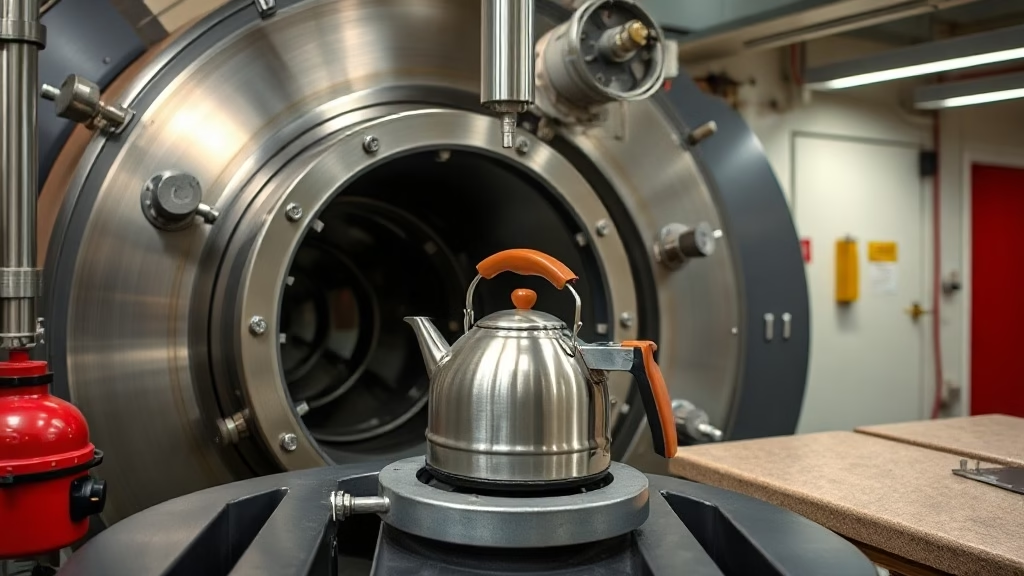
The UK’s remaining operational particle accelerator has been relocated to a staffroom in Geneva, where it currently provides hot water for CERN employees on lunch breaks.
The Linear Accelerator Mark IV, once housed at the Daresbury Laboratory in Cheshire, was quietly decommissioned in March and sold to the European Organization for Nuclear Research for an undisclosed sum. Sources close to the transaction suggest the figure was “enough to refinish three lecture halls at Imperial, maybe four if they skip the disability access bits.”
The equipment now sits beneath a Formica table in CERN’s Building 40 canteen. It boils approximately 1.7 litres of water in four minutes, producing what staff describe as “a decent cup of tea, albeit one that costs roughly £47,000 per brew when you factor in the operational costs.”
Dr Claire Hoffman, formerly a senior researcher at the Rutherford Appleton Laboratory and now a visiting scientist at CERN, confirmed she uses the accelerator daily.
“It’s actually quite efficient once you get past the twenty-minute calibration sequence,” Hoffman said. “Though you do have to sign a waiver if you want your water above 90 degrees.”
The sale marks the end of the UK’s domestic particle physics capability. Britain now relies entirely on European facilities for high-energy research, a arrangement described by the Department for Science, Innovation and Technology as “perfectly adequate” and “very much in the spirit of collaboration.”
DSIT declined to comment on whether the sale was related to the £340 million cut to research infrastructure announced in January. A spokesperson did note that the department had recently invested in “several new whiteboards” and “a really excellent projector for the ministerial briefing room.”
Meanwhile, the UK’s participation in CERN programmes continues under an associate membership costing £85 million annually. This allows British scientists full access to European facilities, provided they relocate to Switzerland and accept salaries approximately 40% higher than their UK equivalents.
Professor James Kendrick, who left Cambridge for a position at CERN in 2019, expressed mixed feelings about his former equipment’s new role.
“I spent eleven years working on that accelerator,” Kendrick said. “We made some genuinely important discoveries about quark-gluon plasma behaviour. Now it’s making Typhoo for a Belgian postdoc who keeps leaving the teabag in.”
The Linear Accelerator Mark IV was Britain’s last remaining particle physics facility following the closure of the Synchrotron Radiation Source in 2008 and the cancellation of the proposed North West Hadron Collider in 2015. That project was abandoned after a cost-benefit analysis determined the £680 million budget could instead fund “nearly eighteen months of arts council grants” or “seven weeks of HS2 consultation fees.”
CERN has reportedly expressed interest in purchasing Britain’s mothballed radio telescopes, though initial discussions suggest they would be repurposed as satellite dishes for the staff gymnasium.