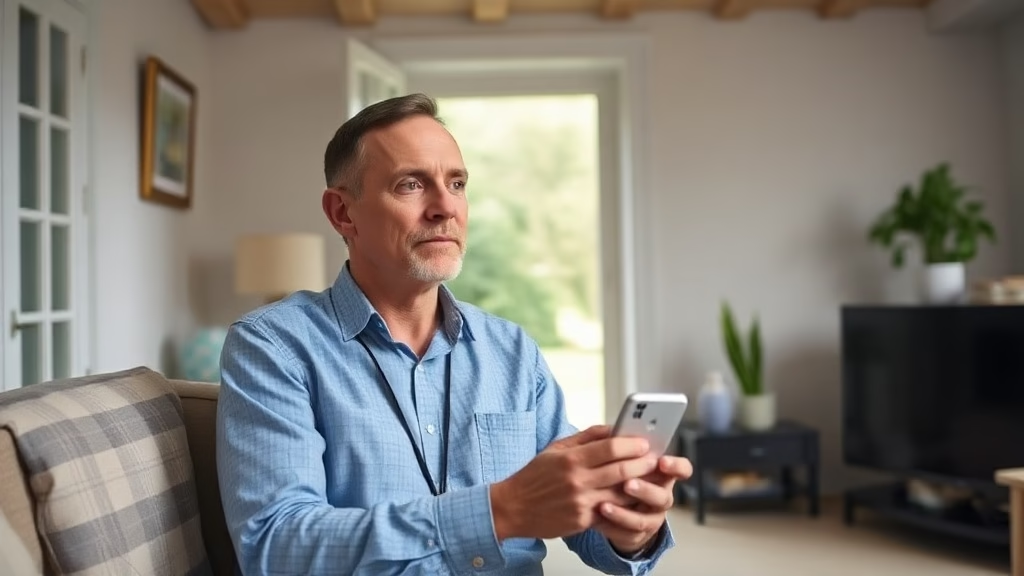
A Nottingham man who spent years refusing to install smart home technology on principle now dedicates approximately six hours per day to managing his smart home technology.
Marcus Webb, 41, first purchased a smart lightbulb in 2022 after his wife pointed out it would save them thirty pence annually on electricity. He now owns 47 separate applications across two phones, maintains three incompatible hub systems, and has described his relationship with his Samsung fridge as “increasingly adversarial”.
“I held out for so long,” Webb said, staring at a wall-mounted tablet displaying what appeared to be a NASA mission control interface but was actually his heating system. “I used to just flick switches. Now I’m mediating territorial disputes between my router and my fridge at two in the morning.”
The fridge, which Webb purchased because it was £40 cheaper than the non-smart version, has begun rejecting firmware updates and periodically announces that it cannot connect to the internet. It is not clear why a fridge requires internet access. Webb has stopped asking.
His morning routine now begins at 5.30am, when he troubleshoots whichever device has stopped communicating with whichever hub overnight. Tuesday’s culprit was a smart plug controlling a lamp. The plug had decided it no longer recognised Webb’s voice commands, despite having no microphone.
“The Zigbee hub won’t talk to the Z-Wave devices, obviously,” explained Webb, speaking in the hollow tone of a man who has seen things. “And the WiFi devices are on three different apps because apparently every manufacturer needs their own ecosystem. My toothbrush has an app. My toothbrush has a privacy policy.”
Dr Helen Pritchard, a researcher at the University of Manchester’s Centre for Digital Domestic Life, said Webb’s experience was increasingly common. “We’re seeing users spend more time managing their convenience devices than they would have spent just doing the actual tasks,” she said. “One participant in our study factory-reset his smart doorbell four times in a week. He’s considering going back to a bell.”
Webb’s partner, Jennifer Cole, 39, reported that their home now contains more hubs than rooms. “We’ve got the Philips one for the lights, the Amazon one for the everything else, and then there’s a third mysterious box that Marcus says is ‘critical infrastructure’,” she said. “I asked him to turn the heating up last week and he needed to consult two apps and reboot something called a bridge.”
The couple’s smart thermostat, which promised to learn their preferences and optimise comfort, has learned their preferences and decided they are wrong. It now maintains the house at a steady 14 degrees while sending helpful notifications about energy savings.
Webb estimates he could resolve most of his issues by switching to a single unified ecosystem, but this would require replacing approximately £3,000 worth of equipment and abandoning the smart radiator valve that only works with an app that was discontinued in 2023.
He has kept the app installed just in case.