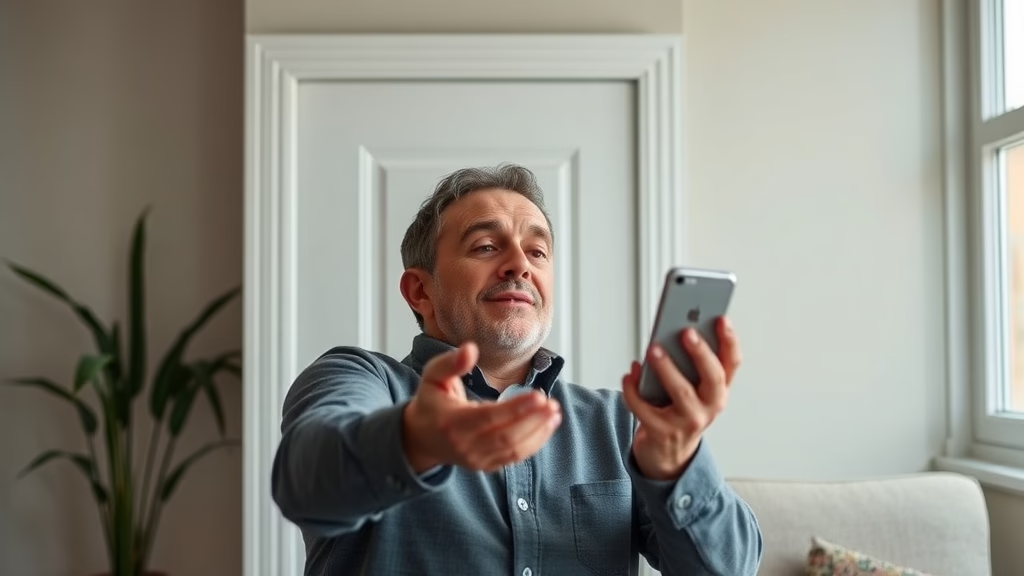
A Manchester homeowner who has invested £2,400 in smart home technology over the past eighteen months continues to physically stand up and walk to light switches, it has emerged.
James Trafford, 34, has installed fourteen Philips Hue bulbs, three Amazon Echo devices, two smart thermostats, a video doorbell, and a wifi-enabled kettle across his two-bedroom flat. He has used voice commands twice, both times to show his parents during a visit in May.
“The system is incredibly intuitive once you’ve set it up,” said Trafford, who spent six hours last weekend troubleshooting why his bedroom lamp had disconnected from the network. “I can control everything from my phone. I just prefer not to.”
The marketing consultant has created seventeen automation routines on his smartphone. None are currently active. His morning routine, which took forty minutes to configure and would gradually brighten the lights whilst playing BBC Radio 4, has been disabled since the second day after it woke him at 6am on a Saturday.
Trafford’s living room features three separate light sources, all controllable via the app, Alexa, or a physical smart switch he mounted over the original switch. He operates them exclusively using the original 1980s toggle switches.
“I did try the voice control,” he explained. “But saying ‘Alexa, set living room to sixty percent’ feels a bit much when someone’s round for a brew.”
His girlfriend, Emma Pritchard, confirmed that Trafford once attempted to dim the lights via voice command before a film. “He had to say it three times because Alexa thought he wanted ‘living room to sixteen percent’,” she recalled. “Then she started playing a Spotify playlist called ‘Sexy Vibes’. We watched Paddington 2 in the dark after he got up and turned them off properly.”
The flat’s smart thermostat, which cost £189 and learns household patterns to optimise heating schedules, is currently set to a constant 19 degrees. Trafford adjusts it manually when cold.
Dr Helen Kavanagh, a researcher in human-computer interaction at UCL, was unsurprised by the findings. “We’re seeing significant investment in connected home ecosystems coupled with what I’d characterise as aggressive non-adoption,” she said. “People enjoy purchasing the capability more than using it. Also, most of these things are a pain in the arse to set up.”
Trafford noted that his video doorbell has proved particularly useful. “I get a notification every time next door’s cat walks past,” he said. “Which is between eleven and fourteen times a day.”
He is currently considering a smart lock for his front door, despite acknowledging he has never once felt that using a key presented significant difficulty.