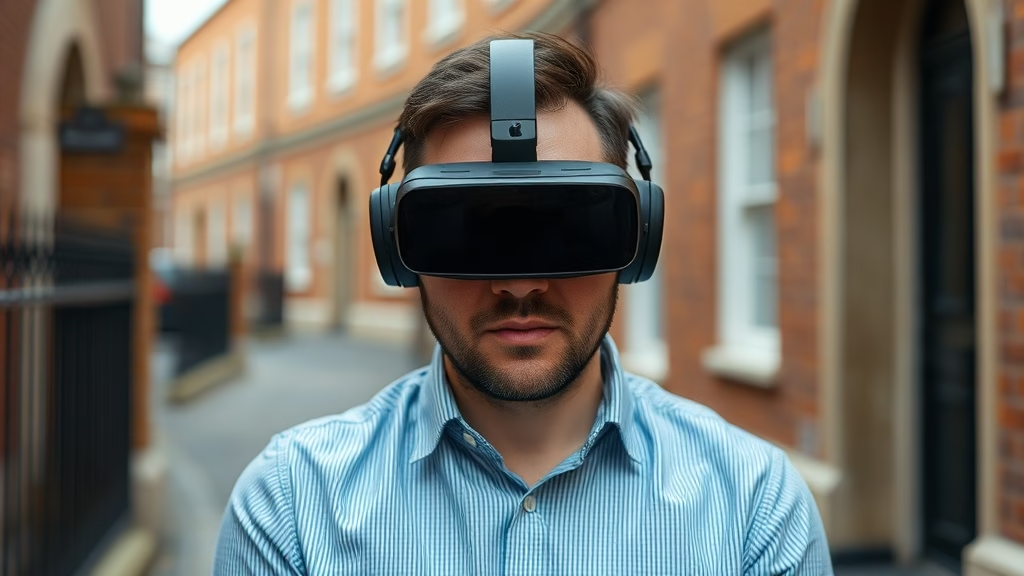
James Thornton, 34, sits in his Guildford living room surrounded by the boxes his Apple Vision Pro 2 came in. He has kept them all. He cannot say why.
“It’s revolutionary,” he tells us, adjusting the headset carefully on the coffee table. “It’s changed everything about how I interact with technology.”
We ask him to elaborate.
“Well, like, I can check the weather. But it’s there. In space. Floating.”
He demonstrates by putting on the £3,000 device. He takes it off again thirty seconds later.
“It said rain,” he confirms.
Thornton, a project manager for a logistics firm, purchased the headset on release day after watching the keynote twice. He had not tried the first Vision Pro. He does not know anyone who owns one.
“The spatial computing aspect is just,” he pauses. “It’s spatial.”
His wife, Rachel, enters with tea. “He’s used it four times this month.”
“That’s not true,” James says.
“Twice then.”
We ask James to walk us through a typical Vision Pro session.
“Right, so I’ll usually set aside proper time for it. Maybe an hour. I’ll clear the room a bit, make sure there’s space. Boot it up. Recalibrate the hand tracking because it’s always slightly off. Then I’ll open the browser and look at a few websites, but bigger. Much bigger than on my laptop.”
Which websites?
“BBC News, mostly. Sometimes Reddit.”
He could do this on his phone.
“But not spatially.”
Rachel returns with biscuits neither of us requested. “Tell them about the Netflix thing.”
James shifts. “The display is incredible for films. It’s like having a cinema in your home.”
“He watched twenty minutes of a documentary about penguins and said his neck hurt,” Rachel adds. “The penguins weren’t even in 3D.”
“The FOV on these things is still limited,” James explains, using an acronym he clearly learned recently. “It’s a first-generation problem. Well, second generation. But first generation of the second model.”
We ask about the killer app. The one thing he couldn’t do before.
“I can arrange my photos in a three-dimensional space around me,” he says. “Like I’m inside my memories.”
Has he done this?
“I’ve meant to.”
Dr. Emma Whitfield, a consumer technology researcher at Manchester Metropolitan University, was unsurprised by our findings. “We’re seeing a lot of expensive justification behaviour. People who’ve spent significant money on devices they use less than their Sodastream.”
Back in Guildford, James is demonstrating the typing interface. He is pecking at virtual keys floating in front of him at roughly one word every six seconds.
“Obviously you wouldn’t write anything long,” he concedes.
Rachel watches from the doorway. “He’s put it on eBay twice. Then taken it down.”
“The resale value isn’t there yet,” James says. “Better to wait for the Pro 3 announcement. Prices might stabilize.”
We ask if he’d recommend the Vision Pro 2 to others.
“Absolutely. If you’re someone who really values spatial computing.”
What does that mean?
“You know,” he says. “Computing. But spatial.”
The battery pack on his coffee table blinks red. It has not been charged in eleven days.