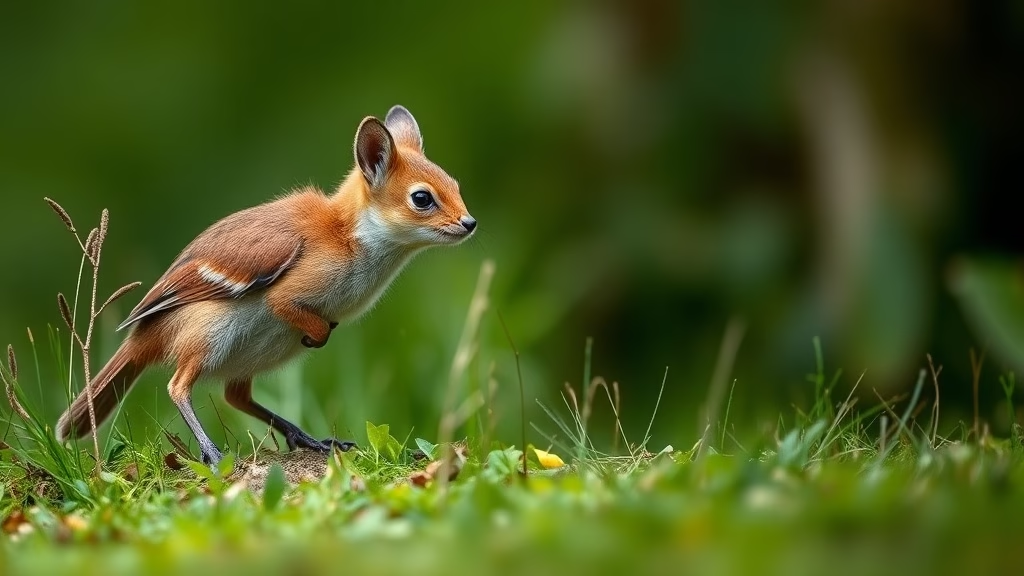
A coalition of British fauna has submitted formal relocation requests to the European Union following what they describe as an unacceptable deterioration in environmental protection standards since 2021. The animals, represented by a delegation of badgers, newts and one extremely patient barn owl, have spent the past eighteen months attempting to work within the new regulatory framework before concluding that the paperwork is simply not fit for purpose.
The move comes after the government replaced several EU directives on habitat protection with what it termed a more flexible, streamlined approach. Wildlife across England and Wales report that this flexibility has largely manifested as a series of confusing guidelines that appear to have been written by someone who had never seen a hedge, let alone understood its function in a functioning ecosystem.
Margaret Howell, a dormouse from Berkshire who has taken on an unofficial coordination role, said the final straw came when she attempted to report a planning violation under the new system. “I filled out the online form three times. Each time it asked me to specify which category of protected status applied to my habitat. The options were ‘Significant’, ‘Quite Important’, and ‘Nice to Have’. My woodland has been continuously occupied since the Iron Age. I did not feel any of these categories conveyed the appropriate level of seriousness.”
The creatures have been particularly troubled by the replacement of specific protection thresholds with what the Department for Environment, Food and Rural Affairs describes as a principles-based approach. This has resulted in what amphibians are calling a governance nightmare. Trevor Sanders, a great crested newt from Staffordshire and former shop steward, explained that his pond was recently redesignated from a protected breeding site to an area of “community value with ecological characteristics”.
“Under the old system, there were maps, measurements, legal definitions. You knew where you stood, or in my case, where you could safely lay eggs,” Sanders said. “Now I’m supposed to trust that developers will take the principles into account. I’ve seen how they interpret principles. They interpret them as optional.”
The Department for Environment, Food and Rural Affairs issued a statement noting that British wildlife should embrace the opportunities afforded by regulatory sovereignty and that the new framework provides a robust, albeit differently structured, level of protection. The statement did not address the animals’ specific complaints, though it did include two paragraphs about the government’s commitment to nature recovery strategies, which several hedgehogs have pointed out remain unfunded.
A smaller group of animals, mainly feral pigeons and some urban foxes, have indicated they are content with the current arrangements. They were not consulted in the original EU regulations either and feel that at least now everyone is equally confused.