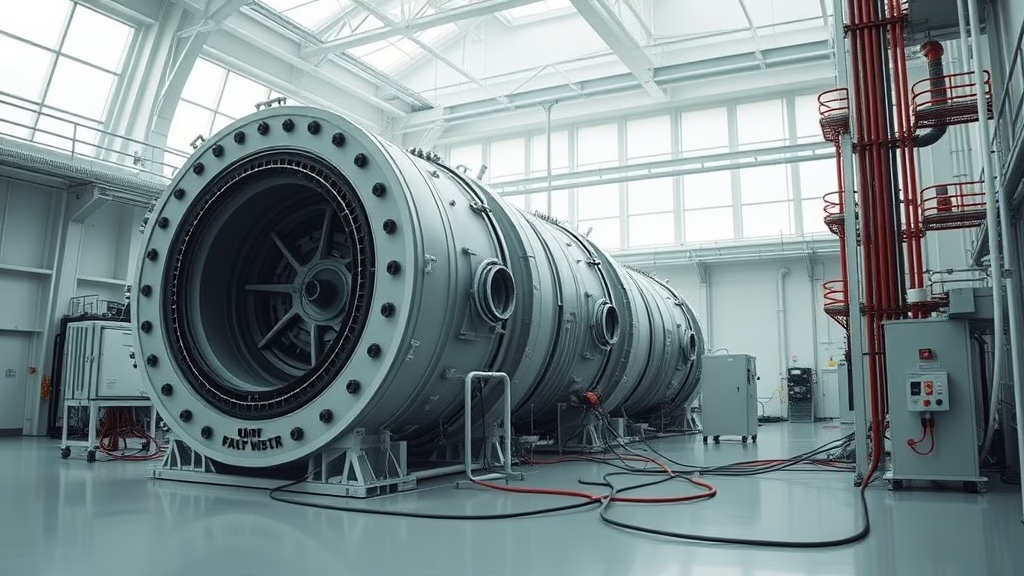
The UK’s flagship fusion energy project has achieved a significant milestone this week after researchers at the Culham Centre for Fusion Energy discovered that several critical components had not been connected to the mains supply.
The Joint European Torus, which has been promising limitless clean energy since 1983, produced a record-breaking plasma temperature of 150 million degrees Celsius. This followed a systematic review of all cables by a doctoral student who noticed that three power supplies were plugged into extension leads that were not switched on.
“This is a watershed moment for fusion science,” said Dr Malcolm Hendry, lead physicist on the project. “We’ve been operating at sixty percent capacity for the better part of eighteen months. Turns out the issue wasn’t the magnetic confinement system or plasma instability. It was the same problem my wife has with the hoover.”
The discovery came during a routine investigation into why the reactor kept shutting down every forty-seven seconds. The research team had spent fourteen months developing increasingly complex theoretical models to explain the phenomenon. They had published six papers on the subject.
The actual cause was identified by Hannah Greaves, a third-year PhD student, during her second week at the facility. She found two plugs behind a filing cabinet and a third tucked into a box labelled ‘misc cables 2019’.
“I just thought I’d check the basics first,” Greaves said. “My supervisor looked at me like I’d suggested we pray to the reactor. But then everything worked.”
The breakthrough represents the latest in a series of incremental advances that bring fusion power to within thirty years of commercial viability. This timeline has remained constant since 1955.
Government officials were quick to celebrate the achievement. The Department for Energy Security and Net Zero released a statement describing the moment as “transformative” and “a testament to British innovation”. The statement made no mention of the plug situation. It did, however, confirm an additional £2.3 billion in funding for the STEP programme, which aims to build a prototype fusion power plant by 2040.
That target date was previously 2035, then 2037, and briefly 2036 before someone checked the calendar.
The Culham facility has now achieved a sustained fusion reaction lasting 5.2 seconds, an improvement on the previous record of 5.0 seconds set in 2022. Scientists estimate they need to maintain the reaction for approximately four hours to generate more energy than the reactor consumes. At the current rate of progress, this milestone should be achievable by 2167.
“People don’t appreciate how complex this work is,” Dr Hendry added. “We’re trying to recreate the conditions inside the sun. Sometimes you miss the obvious things. Last year we spent three months recalibrating the magnetic coils before someone noticed we’d been reading the pressure gauge upside down.”
The reactor is now functioning at full capacity. It will remain operational until Friday, when the building is scheduled to close for roof repairs.