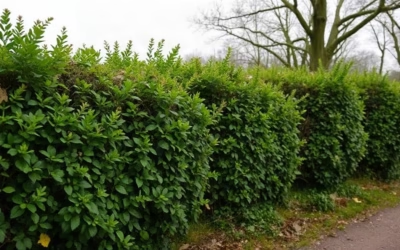
An investigation by this publication has found that approximately seventy per cent of Britain’s carbon offset projects consist of men in hi-vis jackets depositing invasive plant species beside A-roads, then submitting invoices to multinational corporations for between eight and twelve thousand pounds per tonne of theoretical carbon sequestered.
The schemes, which allow companies to continue emitting greenhouse gases whilst technically meeting their net-zero commitments, have evolved considerably since their introduction. What began as ambitious reforestation programmes in certified woodlands has, through a process industry insiders describe as “market efficiency”, become a network of largely unsupervised individuals with access to a van and a garden centre loyalty card.
Martin Hewson, a carbon offset auditor for VerifiGreen Solutions, confirmed that he had approved 847 projects in the past six months without visiting a single site. “We use a robust desktop verification process,” he explained from his office in Basingstoke, where he has worked continuously since March 2022. “If someone sends us a photograph of some vegetation next to a road sign, and the metadata confirms it was taken within the British Isles sometime in the current tax year, that meets our audit criteria. Beyond that, we’re really just checking the invoice adds up correctly.”
The projects themselves rarely involve what environmental scientists would classify as beneficial ecological intervention. One scheme in the West Midlands, which secured £340,000 from a major airline’s offset fund, consisted entirely of scattering bamboo seeds along a nine-mile stretch of the M6 toll road. Another, in North Yorkshire, saw 40,000 saplings planted in a field that was subsequently revealed to be a functioning dairy farm, forcing the owner to remove them with a hedge trimmer over the course of three weekends.
Japanese knotweed, which costs local councils an estimated £166 million annually to control and can grow through concrete, tarmac and occasionally the floors of residential properties, has emerged as the offset industry’s plant of choice. Its aggressive growth rate allows contractors to demonstrate rapid “carbon capture” in before-and-after photographs, whilst its near-indestructibility ensures the vegetation remains visible during any unlikely follow-up audits.
Claire Winters, who previously worked in offset project procurement for a major supermarket chain, said the company had unknowingly funded seventeen separate knotweed installations before someone thought to check. “We’d committed to being carbon neutral by 2025, and these schemes were significantly cheaper than actually reducing our emissions,” she said. “In hindsight, the price probably should have been a warning. You can’t offset a year’s worth of international freight operations for the same amount we spend on middle management team-building exercises.”
The Department for Environment, Food and Rural Affairs declined to comment, noting only that responsibility for offset verification currently sits with a regulatory body that was disbanded in 2019 and never replaced.